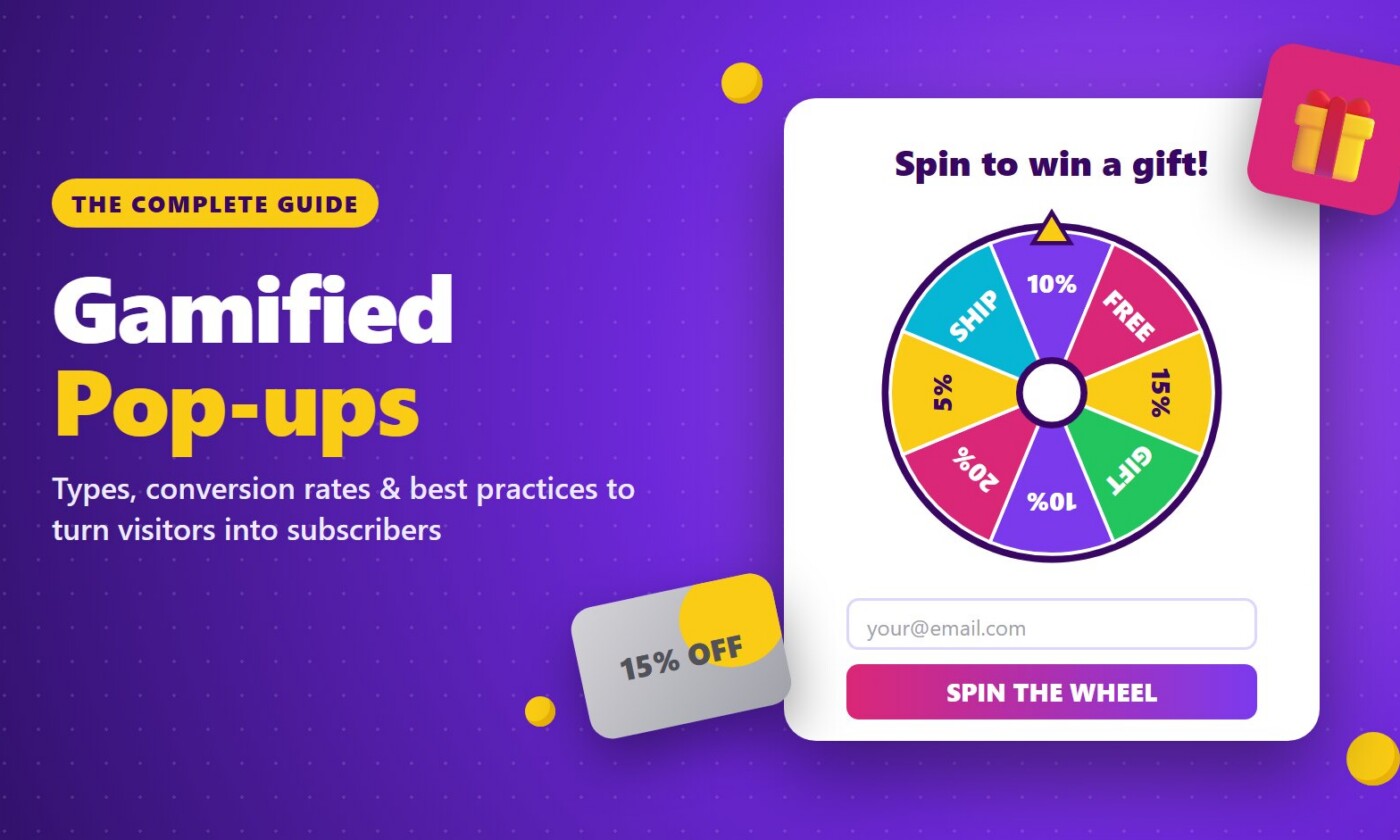
Most shoppers close a standard “Get 10% off” popup before they finish reading it. They have seen thousands of them, and their thumb already knows where the little “×” is. A gamified pop-up changes that reflex. Instead of asking for an email in exchange for a discount, it invites the visitor to play: spin a wheel, scratch a card, pick a gift. The reward is the same, but the experience is completely different.
That difference shows up in the numbers. Several large popup benchmarks report that gamified formats convert roughly twice as well as classic email popups. But the gap is not automatic, and some data shows that a badly designed game simply produces more clicks, not more customers.
This guide covers what a gamified pop-up is, why it works, the main types you can use, what conversion rate you should expect, and how to set one up on your Shopify store without hurting your margins or your brand.
Quick answer: what is a gamified pop-up?
A gamified pop-up is a website popup that turns lead capture into a short mini-game (spin the wheel, scratch card, slot machine, pick a gift…). The visitor enters their email to play and wins a reward, usually a discount code. Benchmarks put typical gamified pop-up conversion rates around 5–9% of displays, versus roughly 2–4% for standard email popups.
Table of Contents
- What Is a Gamified Pop-up?
- Why Pop-up Gamification Works: The Psychology
- Gamified Pop-ups vs Standard Popups: What the Data Says
- 6 Types of Gamified Pop-ups (and When to Use Each)
- What’s a Good Conversion Rate for a Gamified Pop-up?
- How to Set Up a Gamified Pop-up on Shopify
- Best Practices and Mistakes to Avoid
- Gamified Pop-up Ideas by Store Type
- FAQ
What Is a Gamified Pop-up?
A gamified pop-up (also written gamified popup or gamified pop up) is an onsite overlay that uses game mechanics (chance, discovery, play and reward) to get a visitor to take an action. In ecommerce, that action is almost always:
- giving an email address (or phone number) to join your list, and
- receiving a discount, free shipping or gift that pushes them toward a first purchase.
The structure is simple. The popup shows a game and a short promise (“Spin to win a surprise discount!”). The visitor enters their email to unlock a play. The game reveals their prize, and the coupon code is shown on screen and often sent by email too.
What makes it different from a regular discount popup is not the offer. It is the framing. A standard popup says “give us your email and we will give you 10%.” A gamified pop-up says “come play, you might win something nice.” One feels like a transaction; the other feels like entertainment.
Pop-up gamification belongs to the broader family of interactive content marketing: formats that ask the user to participate instead of just reading.
Why Pop-up Gamification Works: The Psychology
Gamified pop-ups are not just “more fun.” They use a handful of well-documented behavioral triggers:
1. Curiosity and the unknown reward
A fixed “10% off” is easy to evaluate and easy to dismiss. An unknown prize is not. People want to close the curiosity gap and find out what they would have won. This is the same variable-reward mechanism that makes loot boxes and scratch tickets compelling.
2. Breaking banner blindness
Shoppers have learned to ignore the standard popup layout. A spinning wheel, a slot machine or a stack of gift boxes looks different enough to interrupt that autopilot and earn a second of real attention, which is all you need.
3. “I won it” beats “I was given it”
A discount that feels earned is valued more than one that is handed out. Visitors who win a code are more likely to want to use it, because letting a prize expire feels like a loss. That is why gamified coupons often show better redemption than generic sitewide codes.
4. Micro-commitment
Clicking “play” is a tiny, low-risk step. Once the visitor has started, entering an email to see the result feels like a natural continuation, not a new decision.
5. Positive brand association
A popup that makes someone smile is remembered very differently from one that blocks the page. A well-designed game makes your store feel playful and generous instead of pushy.
Gamified Pop-ups vs Standard Popups: What the Data Says
Popup benchmarks are notoriously hard to compare, because each vendor defines “conversion” differently (per display, per visitor, per click). Still, the large public datasets point in the same direction:
| Source | Dataset | Gamified / spin-to-win | Standard popup |
|---|---|---|---|
| Sleeknote | 26,270 campaigns (2025 data) | 8.67% | 3.70% |
| Claspo | 2026 popup benchmark | 8.08% average | 3.67% |
| Wisepops | 1B+ popup displays | 7–9% | ~4–5% |
| Omnisend | 1.24B displays (2025) | n/a | 2.1% average signup rate |
In other words, a gamified pop-up typically lands at about 2x the conversion rate of a classic email capture form.
There is an important counterpoint. Popupsmart’s 2026 benchmark of 28,674 campaigns found that gamified popups drew far more clicks than plain popups (7.33% vs 1.87% of displays), but did not always collect measurably more leads. The lesson: a game alone does not do the job. If the email step is confusing, the prizes are weak, or the popup shows at the wrong time, people will happily play and leave.
The gamified pop-ups that win combine three things: a game that is quick to understand, rewards worth playing for, and a clean email step before the reveal.
6 Types of Gamified Pop-ups (and When to Use Each)
Here are the most common types of gamified pop-ups used by Shopify stores, all of which are available as templates in SmashPops.
1. Spin the Wheel
The classic “spin to win.” The visitor spins a prize wheel with several segments (10% off, 15% off, free shipping, free gift…) and lands on one.
Best for: welcome offers and broad list growth. Everyone understands it instantly, which makes it the safest first test.
2. Scratch Card
The visitor scratches a virtual card with their mouse or finger to reveal the prize underneath.
Best for: mobile traffic (scratching with a thumb feels natural) and brands that want a slightly more premium, “surprise” feel than a wheel.
3. Slot Machine
Three reels spin and stop on a combination that reveals the reward. It has more suspense and motion than a wheel.
Best for: playful brands, flash sales, Black Friday and holiday campaigns where energy and excitement fit the moment.
4. Pick a Gift
Several gift boxes are shown; the visitor chooses one to open. It gives a sense of control (“I picked this one”) on top of the surprise.
Best for: gifting periods (Christmas, Valentine’s Day, Mother’s Day) and beauty, fashion or lifestyle stores.
5. Card Dance (card shuffle)
Cards are shuffled in front of the visitor, who then picks one to flip and reveal the prize. It is a light memory/attention game.
Best for: standing out when your audience has already seen many spin-to-win wheels on other stores.
6. Claw Machine
Inspired by arcade claw machines: the visitor drops the claw to grab a prize. It is the most “arcade” of the formats and very memorable.
Best for: younger audiences, toys, gaming, snacks, novelty and gift shops.
| Game type | Understood in | Mobile experience | Novelty | Ideal use |
|---|---|---|---|---|
| Spin the Wheel | < 1 second | Good | Medium | Welcome offer, first test |
| Scratch Card | < 1 second | Excellent | Medium | Mobile-heavy stores |
| Slot Machine | 1–2 seconds | Good | High | Sales events, BFCM |
| Pick a Gift | < 1 second | Excellent | High | Seasonal & gifting |
| Card Dance | 1–2 seconds | Good | High | Beating “wheel fatigue” |
| Claw Machine | 1–2 seconds | Good | Very high | Playful, younger brands |
Want to see how these compare with non-gamified formats like exit-intent or quiz popups? Our pop up example roundup breaks down seven strategies and the tools that fit each.
What’s a Good Conversion Rate for a Gamified Pop-up?
Measured as emails collected ÷ popup displays, here is a practical scale for a Shopify store:
- Below 3%: underperforming. Check timing, prizes and the email step first.
- 3–5%: average. The game works, but there is room to optimize.
- 5–10%: good. In line with the benchmarks above.
- Above 10%: excellent. Usually means strong targeting (returning visitors, engaged pages, exit intent) and attractive rewards.
Two things move the number more than anything else:
- Traffic quality and timing. A game shown to a visitor who has scrolled half a product page will always beat one fired at 0 seconds on the homepage.
- Prize value. If every slice is “5% off,” visitors notice. Mixing in free shipping, a free gift or one higher-value segment makes playing feel worthwhile.
Do not stop at signup rate. Track coupon redemption and revenue from coupon codes too. A popup with a slightly lower signup rate but stronger redemption is the better campaign.
How to Set Up a Gamified Pop-up on Shopify
Here is the process with SmashPops. The same logic applies to any gamified popup tool.
Step 1: Install the app and choose a game
Install SmashPops from the Shopify App Store and pick one of the six game templates. If this is your first gamified campaign, start with Spin the Wheel or Scratch Card. They are the easiest to understand. If you need a walkthrough, follow our guide on how to set up your first campaign.
Step 2: Design your prizes (and protect your margin)
This is the most important step. Decide what each segment or card offers and how often it should win. A healthy mix usually includes:
- one or two “common” prizes (e.g. 10% off, free shipping),
- one “medium” prize (e.g. 15% off or a free sample),
- one rare “jackpot” (e.g. 20–25% off or a free product) with low odds.
Make sure every play wins something. “Try again” segments frustrate people and kill trust. Use our Shopify profit margin calculator to check that your biggest discount still leaves you profitable.
Step 3: Use unique, one-time coupon codes
A single shared code (“SPIN10”) ends up on coupon sites within days. Generate unique one-time codes instead, so each prize can only be used once by the person who won it. See how to set up automatically generated coupons.
Step 4: Customize the look
Match colors, fonts and background to your brand so the popup feels native to your store, not like a third-party ad. Keep the copy short: a headline (“Spin for a surprise gift 🎁”), one line of explanation, the email field and the button.
Step 5: Set the right triggers
Targeting is where most of the performance comes from. Useful triggers include:
- Exit intent: show the game when the visitor is about to leave (learn more about exit-intent technology).
- Scroll position: wait until the visitor has scrolled 40–60% of a page.
- Number of visits: target second-time visitors who are clearly interested.
- Page, device, referrer and country: tailor the game and prizes to each audience.
The display rules guide explains each setting in detail.
Step 6: Connect your email provider
Send every email you collect to Klaviyo, Mailchimp, AWeber or a CSV export, and trigger a welcome flow that includes the prize. See our tutorials for sending the coupon via email with Omnisend and with Mailchimp.
Step 7: Filter out junk emails
Because the game is fun, some people enter fake addresses just to play. Turn on junk email detection so your list stays clean and your deliverability stays healthy. More tips in how to improve the quality of the emails you collect.
Step 8: Add a coupon reminder bar
Many winners close the popup and keep browsing. A small coupon reminder bar keeps their code visible on every page until checkout, which is one of the simplest ways to lift redemption.
Best Practices and Mistakes to Avoid
Do
- Ask for the email before the reveal. The game is the hook; the result is the reward for signing up.
- Keep it under 10 seconds. From popup open to prize reveal, the whole experience should be quick.
- Design for mobile first. Large tap targets, a short form, an easy close button. On mobile, Google penalizes intrusive interstitials that cover content right after landing from search, so delay the popup or use a teaser. Our mobile conversion optimization guide covers this.
- Use a popup teaser. A small floating “🎁 Win a gift” tab lets visitors open the game when they are ready, instead of forcing it on them.
- Add urgency to the prize. A coupon valid for 24–48 hours converts better than one with no expiry.
- Rotate games seasonally. Swap the wheel for Pick a Gift at Christmas or a Slot Machine for Black Friday to keep things fresh for returning visitors.
Don’t
- Don’t show it on every page view. Once someone has played or closed the popup, leave them alone for a while.
- Don’t fake the odds. If you advertise a free product, someone has to be able to win it. Misleading games damage trust and can create legal issues.
- Don’t require a purchase to play. Free-to-play games where every player wins something are the standard for a reason. If you run anything closer to a sweepstakes, check the rules that apply in your country.
- Don’t stack popups. One gamified popup beats a newsletter box, a cookie banner and a spin wheel all fighting for attention at once.
- Don’t forget accessibility. Make sure the popup can be closed with the keyboard and that prize text is readable. See our notes on Shopify accessibility.
Gamified Pop-up Ideas by Store Type
Not sure where to start? Here are a few campaign ideas you can adapt:
| Store type | Game | Trigger | Prize mix |
|---|---|---|---|
| Fashion / apparel | Spin the Wheel | 2nd page view, 50% scroll | 10% off, 15% off, free shipping, free tote (rare) |
| Beauty & skincare | Pick a Gift | Exit intent on product pages | Free sample, 10% off, free shipping, free mini-size (rare) |
| Food & snacks | Claw Machine | Returning visitors | Free snack with order, 10% off, free shipping |
| Home & decor (higher AOV) | Scratch Card | Exit intent, cart page excluded | €10 off, €20 off over €150, free delivery |
| Black Friday campaign | Slot Machine | Homepage, 5-second delay | Extra 5–10% on top of sale prices, early access |
Whatever you pick, run it for at least two weeks before judging it, then test one variable at a time: game type, prize mix or trigger.
FAQ
What is pop-up gamification?
Pop-up gamification is the practice of adding game mechanics (spinning, scratching, picking, chance and rewards) to website popups. Instead of a static form, visitors play a short game to unlock a discount or gift, which increases engagement and email signups.
What are the types of gamified pop-ups?
The most common types are Spin the Wheel, Scratch Card, Slot Machine, Pick a Gift, card games (like Card Dance) and Claw Machine. Quiz popups and countdown challenges are sometimes included too, but the six above are the most used in ecommerce.
Do gamified pop-ups really convert better?
On average, yes. Benchmarks from Sleeknote, Claspo and Wisepops report gamified popups converting at roughly 7–9% of displays, about twice the rate of standard email popups. Results depend heavily on timing, prize value and a clear email step.
Are gamified pop-ups bad for SEO?
Not if you use them carefully. Avoid full-screen popups that cover content immediately after a mobile visitor lands from Google. Use a delay, scroll or exit-intent trigger, or a small teaser that opens the game on click.
Do gamified pop-ups work on mobile?
Yes, and some formats work even better on mobile. Scratch cards and Pick a Gift are natural to use with a thumb. Just keep the form short and make the close button easy to tap.
Will a spin-to-win popup make my brand look cheap?
Only if it looks generic. Customize the colors, fonts and copy to match your brand, offer meaningful prizes and limit how often it appears. Done well, a game feels generous and playful, not cheap.
Turn your popup into a game your visitors actually want to play
SmashPops gives Shopify stores six ready-made games, unique one-time coupons, smart triggers and Klaviyo/Mailchimp integrations. Try it free for 7 days.
