Popup benchmarks regularly show a wide spread between average campaigns and top performers. That gap comes from timing, targeting, and offer quality far more than the format itself.
Shoppers usually hate popups that appear too early, repeat too often, or ask for an email before the store has earned any interest. Stores get better results when the popup matches a clear moment in the visit. Exit-intent for abandoning product viewers. A quiz for first-time visitors who need help choosing. Gamified offers for list growth when standard discount boxes have gone stale.
That is the lens for this article. It gives a practical breakdown of seven popup strategies and the tool that fits each one best, so Shopify teams can choose software based on the pop up example they need to build.
For stores dealing with popup fatigue, gamification is often the fastest way to improve engagement without raising discount pressure. A Shopify popup app built for spin-to-win and other interactive formats can turn the same email capture goal into an experience that feels more like participation than interruption.
The common thread is simple. Good popups respect intent, earn attention, and support conversion instead of getting in the way.
Table of Contents
- 1. SmashPops
- 2. OptiMonk
- 3. Wisepops
- 4. Justuno
- 5. Sleeknote
- 6. OptinMonster
- 7. Poptin
- Top 7 Pop-Up Tools Comparison
- Which Pop Up Strategy Is Right for Your Store?
1. SmashPops
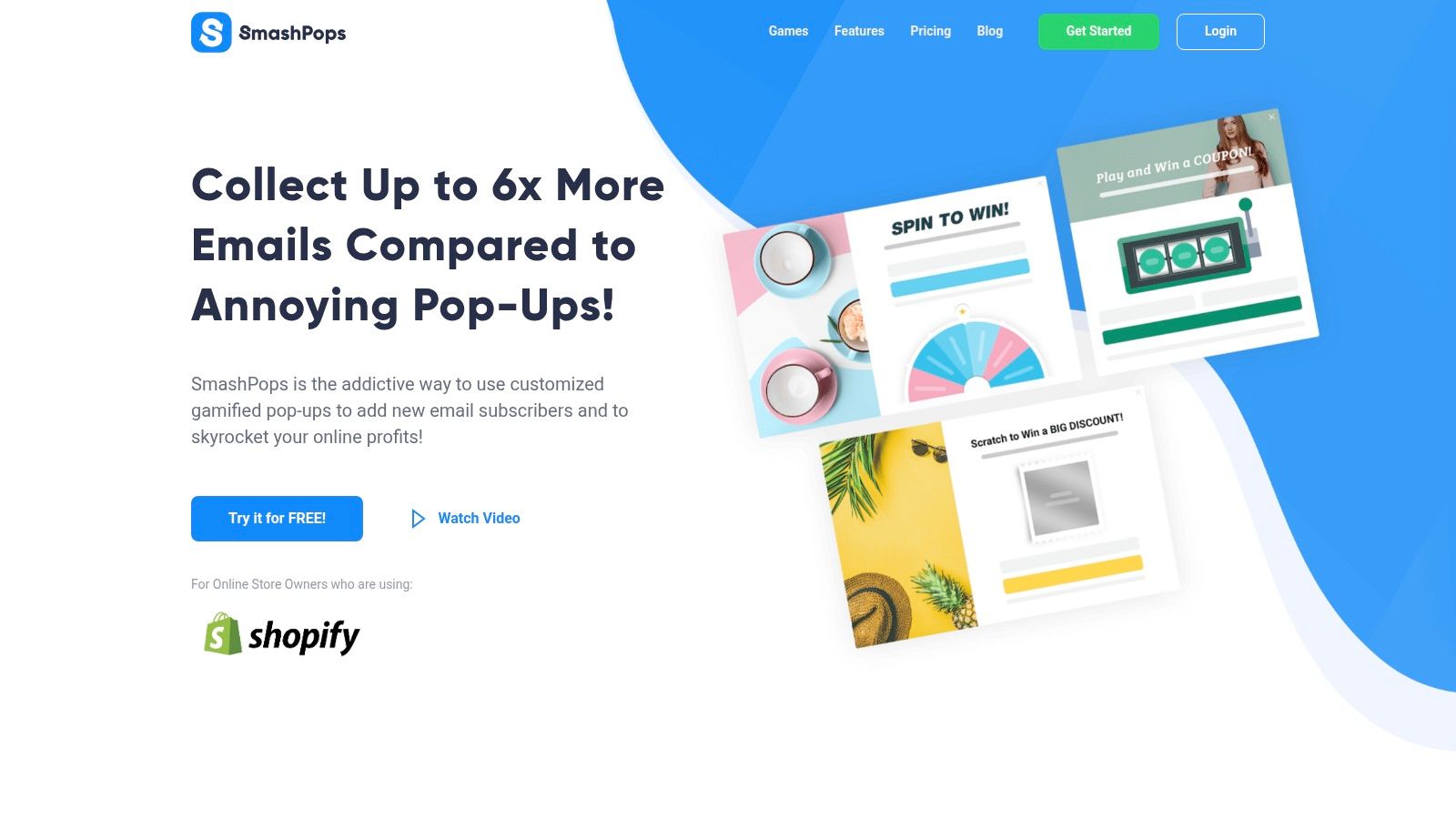
Some popup formats still break through fatigue. Gamified popups are one of the few that can change shopper behavior because they replace the standard email box with a short interaction and a clear reward.
That makes SmashPops a strong fit when the pop up example you need is gamification. Instead of recycling the same discount modal every Shopify store uses, it lets you build Spin the Wheel, Slot Machine, Scratch Card, Pick a Gift, Claw Machine, and Card Dance campaigns that feel more like an offer experience than an interruption.
Why SmashPops is the best gamified pop up example
SmashPops focuses on ecommerce execution and goes well beyond simple novelty. The editor gives you control over colors, fonts, backgrounds, copy, coupon settings, and display rules, so the popup can match the store instead of looking pasted on top of it. It also supports the targeting options that usually decide whether a popup performs or gets ignored, including exit intent, scroll depth, device type, visit count, referrer, and country.
That combination matters on Shopify.
A first-time mobile visitor from Meta ads should not see the same popup as a returning desktop shopper browsing a high-intent collection page. SmashPops lets you build around that reality. If you want to pair game mechanics with higher-intent triggers, this guide to exit-intent popup technology and timing is a useful starting point.
Practical rule: Gamification works best when the reward stays controlled. Use one-time coupon generation and clear eligibility rules so you grow the list without teaching shoppers to wait for the next discount.
A few product details make SmashPops especially useful for coupon-led Shopify stores:
- Unique coupon code support: You can issue one-time codes instead of recycling a public discount that ends up on coupon sites.
- Fake email filtering: Automatic junk-email detection helps cut down on repeat spins and low-quality submissions.
- Core retention integrations: Klaviyo, MailChimp, AWeber, Zapier, and CSV export cover the stack many small and mid-sized stores already use.
- Commerce-focused reporting: You can measure impressions, email captures, conversion rate, coupons issued, and sales attribution where integrations support it.
Where it works best on Shopify
SmashPops works best for top-of-funnel list growth and first-order conversion, especially in categories where a playful offer fits the buying mood. I would test it first on beauty, accessories, gifts, snacks, pet, and other impulse-friendly products where a spin or scratch mechanic feels natural instead of forced.
The trade-off is brand fit. Luxury stores, regulated categories, and brands already dealing with discount dependency should use gamified popups selectively, often only for first-time visitors or softer rewards such as free shipping. If you want more setup ideas, their guide to choosing a Shopify popup app for list growth is a useful reference.
One more consideration. Public pricing beyond the free 7-day trial is not listed on the site, so teams comparing tools side by side will need to start the signup flow before they can judge paid-plan fit.
2. OptiMonk
OptiMonk is the tool I'd choose when the pop up example you need is an exit-intent save, but you still want solid targeting depth and a clean Shopify workflow. A lot of popup tools claim exit-intent support. Fewer handle segmentation, surveys, and campaign management in a way that still feels manageable for a marketing team.
Exit-intent remains useful because it catches shoppers at the moment they're about to abandon. Independent research puts exit-intent popup conversion at 3.94% in one dataset, and another benchmark places exit-intent popups in the 3% to 4% range while noting they can recover 10% to 15% of departing visitors who would otherwise leave without converting (B2B and ecommerce popup trigger benchmarks).
Best for exit-intent with cleaner targeting
OptiMonk's strength is that it doesn't force you into the old “wait for cursor movement, show discount, hope for the best” model. You can pair desktop and mobile exit-intent with other triggers and segment logic, then route data back into Shopify workflows. The AI helpers and headline support are useful, but its core benefit is operational. Unlimited campaigns and features within plan tiers make testing easier when you want multiple save offers running by audience or page type.
Use OptiMonk when your abandoned-visitor strategy needs more nuance than one blanket modal. Good examples include:
- Cart savers: Show a shipping reassurance or limited incentive only to high-intent cart visitors.
- Collection-page capture: Trigger on category browsers who engage but don't add to cart.
- Survey-led exits: Ask why someone is leaving, then tag them in Shopify for better follow-up.
Use exit-intent when a visitor has already signaled disengagement. Don't use it as a license to interrupt everyone earlier in the session.
The main trade-off is pricing logic. Pageview-based plans are predictable, but content-heavy stores can hit thresholds faster than expected. Some broader personalization features also sit outside the core popup use case. Still, for stores that want a disciplined exit-intent program, OptiMonk is one of the cleaner choices. If you're comparing trigger philosophy, this explainer on how exit-intent technology works in practice is also useful context.
3. Wisepops
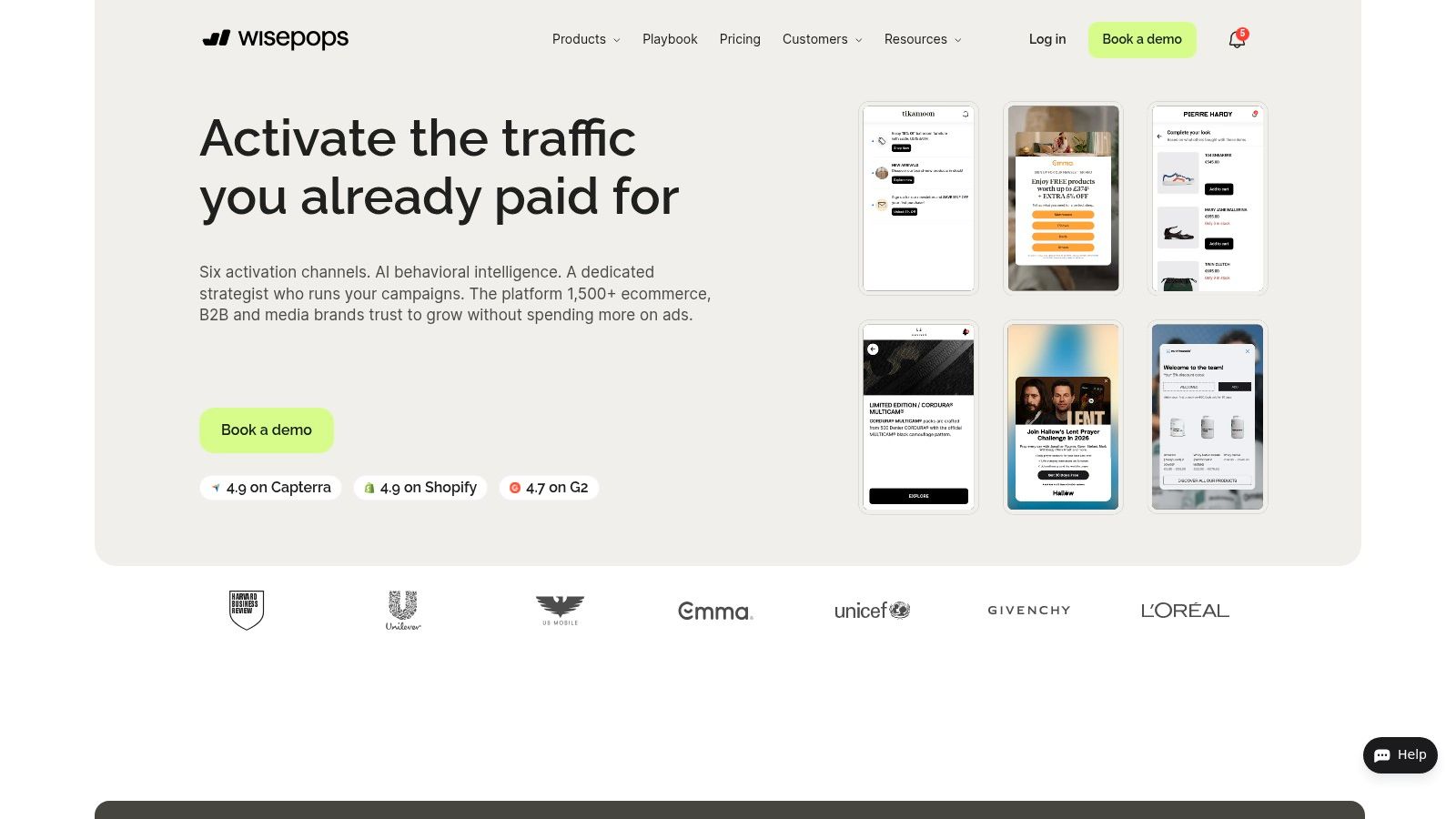
Stores that already capture email often hit a different problem. Shoppers still hesitate because they have not found the right product, and a standard discount popup does nothing to resolve that. Wisepops fits that use case well because it can turn a popup example into a guided path instead of a one-step interruption.
Wisepops supports more than classic popups, including branching flows, quizzes, embeds, bars, onsite feeds, and optional web push. That range matters for Shopify brands that want to ask a few useful questions, route visitors toward a collection or recommendation, and collect cleaner zero-party data along the way.
Best for quiz-style and branching pop up examples
The strongest Wisepops strategy is the quiz popup. Use it when the visitor needs help choosing, not just a reason to subscribe. Apparel stores can segment by fit or style. Skincare brands can segment by concern or routine. Food and beverage brands can sort by flavor preference, caffeine tolerance, or dietary restrictions.
This format works because it trades one generic ask for a short decision flow. The popup example becomes a qualifier. If someone arrives from a paid ad for dry-skin products, the first question can confirm that need, then send them to the right products and tag them for follow-up inside Shopify or your ESP.
That targeting advantage has shown up repeatedly in popup performance research from Wisepops, where more relevant campaigns outperform generic ones in broad benchmark datasets. The practical takeaway is simple. If traffic source, product complexity, or shopper intent varies a lot, a branching popup will usually beat the same email form shown to everyone.
A few strengths stand out here:
- Branching logic: Each answer can send shoppers to a different next step, offer, or recommendation.
- Alternative placements: Embeds and onsite feeds help you gather intent without forcing another full-screen modal.
- Onsite messaging in one tool: You can run lead capture, product guidance, and announcement campaigns from the same system.
A strong quiz popup helps the shopper make a choice, then gives your retention stack better segment data to work with.
The trade-off is evaluation friction. Wisepops does not publish pricing, so smaller teams may need a sales conversation before they can compare it against self-serve apps. Web push also tends to be audience-dependent, so I would treat that as a secondary feature, not the reason to buy.
For Shopify stores building a product finder, shade matcher, routine builder, or other guided-sell popup example, Wisepops is a strong fit. If you want ideas for making those experiences more engaging without falling back on another generic email box, this guide to interactive content marketing tactics for ecommerce is a useful starting point.
4. Justuno
Justuno is the tool for teams that don't have a popup problem. They have a segmentation problem. They know broad offers waste margin, low-quality leads pollute flows, and generic campaigns stop working once traffic volume grows.
Its biggest advantage is rule depth. You can get granular about who sees what, then test variations with more discipline than you'll get from entry-level popup apps. That makes Justuno a better fit for mid-market and enterprise ecommerce brands running multiple promotions across multiple audience states.
Best for advanced segmentation and lead quality control
Justuno is strongest when the pop up example needs strict audience qualification. Think VIP-only offers, returning-visitor promotions, traffic-source-specific messages, or product-category overlays that change based on cart contents and behavior. It also includes real-time email and phone verification, which matters if list quality is as important as list size.
The quality angle is often overlooked. A popup that captures junk leads can make the dashboard look good while making your email program worse. Verification tools help reduce that problem before bad data ever reaches your ESP.
What I like here is the combination of targeting and testing:
- Dynamic segmentation: Useful when one campaign shouldn't hit every visitor equally.
- A/B and multivariate testing: Better for serious CRO teams than simple “duplicate campaign and edit headline” workflows.
- Lead verification and blocker mitigation: Practical features for stores battling fake signups or visibility issues.
The trade-off is complexity. Justuno has more moving parts, and pricing can climb with traffic. If your team won't use the advanced rule engine, you're paying for depth you may not need. Still, if your store has enough scale that popup campaigns need to behave like a performance channel, Justuno is a credible choice.
5. Sleeknote
Sleeknote fits a different kind of team. It isn't trying to be the flashiest option in this list. It's for marketers who want polished popups, straightforward implementation, and strong Shopify and Klaviyo compatibility without building a complex onsite messaging program from scratch.
For many stores, that's enough. A clean list-building popup, a welcome offer, and a few page-specific forms can drive meaningful results when they're timed well and integrated properly.
Best for polished list-building popups that are easy to launch
Sleeknote works well when the popup strategy is conventional, but execution quality still matters. Good examples include a first-order welcome offer, a category-specific signup prompt, or a content upgrade on a buying guide. The builder and templates help teams move fast without handing every request to design or development.
That kind of restraint matters because poor timing can easily hurt the experience. Nielsen Norman Group argues that popups often appear at the wrong time, interrupt critical tasks, and disorient users, and recommends delaying them until they're contextually relevant or replacing them with less intrusive banners or nonmodal overlays (NN/g guidance on popup UX tradeoffs). Sleeknote's cleaner design style lends itself well to that less aggressive approach.
A practical use case for Sleeknote is when you want:
- A polished welcome popup: Branded, fast to launch, and connected to your email flows.
- A softer onsite capture layer: More refined than a hard-sell discount box.
- Reliable Shopify and Klaviyo workflows: Especially for teams already operating inside those tools.
The downside is that public pricing isn't easy to compare from a standard pricing table, and the tool is less publicly associated with deep testing frameworks than CRO-heavy platforms. But for stores that want a dependable, clean pop up example without overcomplicating the stack, Sleeknote is a solid fit.
6. OptinMonster
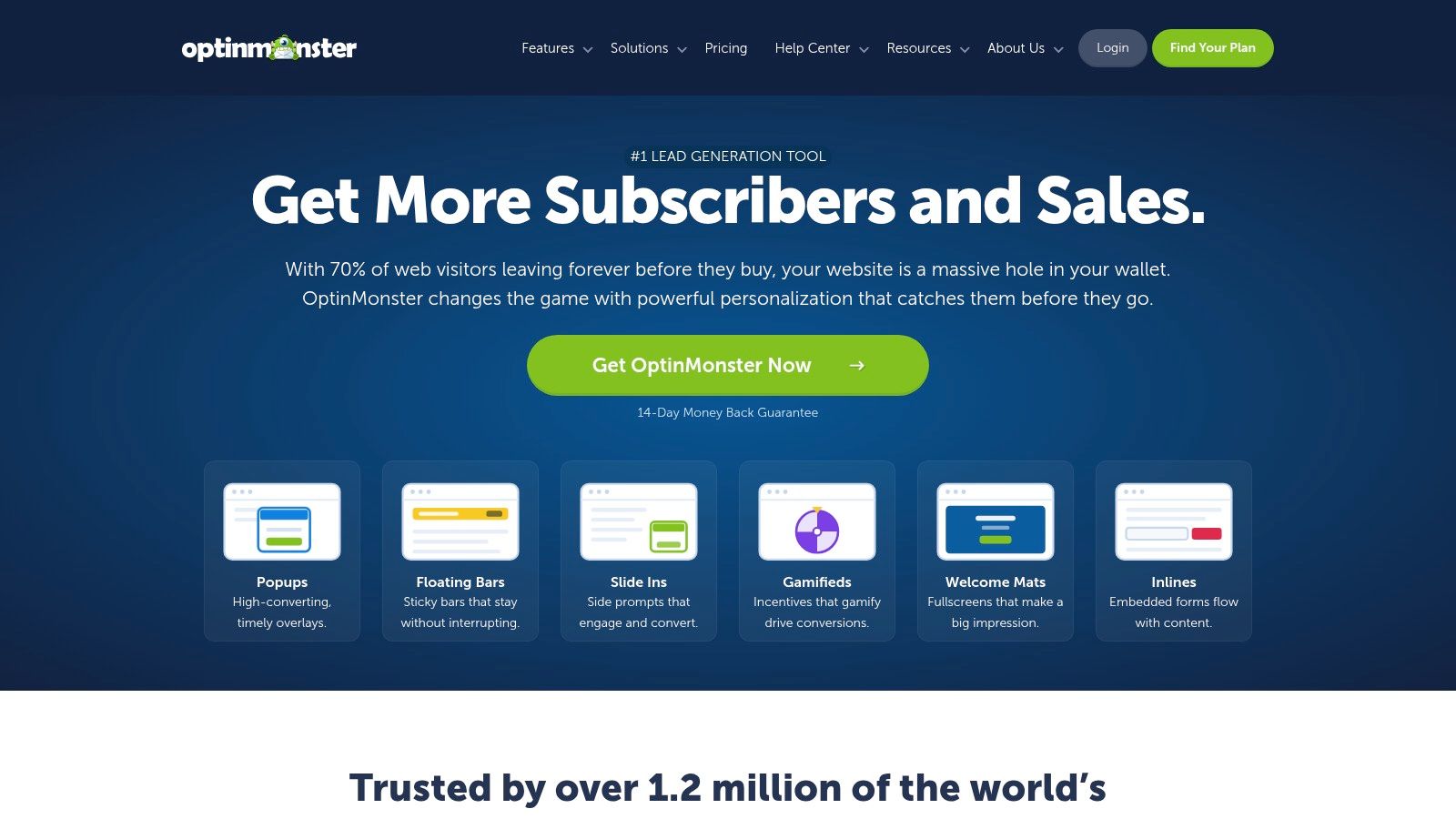
OptinMonster fits the store that wants to test several popup strategies before committing to one. That matters because popup fatigue is real. A static 10% off box shown to everyone usually stops performing long before the team admits it. If the job is to compare formats, triggers, and audience rules in one system, OptinMonster is one of the more practical options.
Best for multi-variant pop up examples and testing-heavy teams
The strongest pop up example for OptinMonster is a testing program, not a single campaign. A Shopify team might run a yes/no popup for cold traffic, an exit-intent offer for product-page abandoners, and a returning-visitor message that swaps a discount for a bundle pitch. OptinMonster handles that kind of setup well because its targeting rules are broad and its campaign types cover more ground than a narrower specialist tool.
That makes it useful for stores still finding message-market fit on site. If SmashPops is the clear pick for gamified popups, OptiMonk for exit-intent, and quiz tools for guided product discovery, OptinMonster is the one to use when the question is still open and the team wants evidence before specializing.
A strong use case is mobile-specific testing. Mobile visitors behave differently, and popup layouts that look fine on desktop often break the experience on a phone. The right move is to test mobile timing, shorter copy, and simpler form fields instead of shrinking a desktop popup and hoping for the same result.
OptinMonster gives you the controls to do that:
- Broad trigger coverage: Exit-intent, inactivity, scroll depth, referrer, UTM parameters, cookies, and custom JavaScript conditions.
- Flexible campaign formats: Standard popups, floating bars, fullscreen campaigns, yes/no flows, and coupon-wheel style campaigns on higher plans.
- Useful segmentation for paid traffic: Helpful when Meta, Google, email, and affiliate traffic need different offers and different timing.
The trade-off is complexity. A platform built for lots of tests can produce lots of average campaigns if the offer strategy is weak or the team launches too much at once. Pricing also climbs as you need more advanced targeting and ecommerce features.
Used with discipline, OptinMonster is a strong fit for merchants who want each pop up example to answer a real CRO question, not just collect another email.
7. Poptin
Poptin is the pick for merchants who need something simple, affordable, and fast to deploy. Not every store needs enterprise segmentation, branching quizzes, or a gamified experience. Sometimes you just need a competent popup app with useful triggers, a free tier, and enough control to launch offers without overthinking it.
That's where Poptin makes sense. It covers the basics well, including exit-intent, time-based triggers, scroll-based triggers, manual triggers, autoresponders, and A/B testing.
Best for simple budget-friendly pop up examples
Poptin is a good fit for smaller Shopify stores, early-stage brands, agencies managing smaller clients, or teams that need several straightforward campaigns across different domains. If your pop up example is a simple homepage signup, a blog-content capture, or a cart-exit offer, it can get the job done without a big learning curve.
That said, simple tools still need smart timing. Independent guidance on popup triggers increasingly emphasizes scroll depth, time on page, device type, visit count, referrer, and traffic-source segmentation, while also warning that mobile and interruptive formats need restraint (behavior-based popup timing guidance). Poptin gives you enough trigger control to apply that thinking even if you're not using a premium platform.
A good way to use Poptin is to keep the campaign set narrow:
- One welcome popup for new visitors
- One exit-intent offer for cart or product pages
- One embedded or manually triggered form for lower-friction capture
Keep budget popup programs boring in the right places. Fewer campaigns, better timing, cleaner copy.
The limitation is depth. Analytics and advanced personalization won't match tools aimed at larger teams, and free-tier branding may be a dealbreaker for some stores. But if low-cost implementation matters most, Poptin is one of the better entry points.
Top 7 Pop-Up Tools Comparison
| Product | 🔄 Implementation complexity | ⚡ Resource requirements | 📊 Expected outcomes | Ideal use cases | ⭐💡 Key advantages / Tips |
|---|---|---|---|---|---|
| SmashPops | Low, Shopify app, plug‑and‑play with customization | Low–Medium, Shopify + email tool integrations; minimal dev | High email capture uplift (claims up to 6x) and coupon-driven sales lift (up to ~30%) | Shopify stores focused on list growth and coupon conversions; agencies/freelancers | Gamified templates (6); strong triggers, one‑time coupons, analytics; try 7‑day free |
| OptiMonk | Medium, AI‑assisted builder; requires configuration and testing | Medium, pageview‑based plans; deep Shopify flows and AI features | Predictable conversion improvements from targeted popups; good exit‑intent performance | Shopify merchants needing AI copy/experimentation and multi‑domain agencies | Transparent pricing (free tier 10k pv); AI headline generator; unlimited campaigns per tier |
| Wisepops | Medium–High, branching flows and onsite feeds require design and QA | Medium–High, broader feature set (feeds, quizzes, optional web push) | Richer engagement and segmentation; better guided‑selling outcomes vs simple popups | Brands wanting multi‑placement onsite messaging, quizzes, and guided selling | Branching quizzes, onsite feed/embed options, revenue‑aware reporting; web push available |
| Justuno | High, enterprise workflows, detailed rules and testing setup | High, scales with traffic/unique visitors; may need specialist support | Strong segmentation, higher lead quality, robust A/B/multivariate results | Mid‑market to enterprise ecommerce and CRO teams | Advanced targeting/testing, real‑time verification, visibility boost vs blockers |
| Sleeknote | Low–Medium, guided setup, polished builder for marketers | Medium, sessions‑based pricing; strong Klaviyo/Shopify integrations | Fast activation and consistent popup performance within ecommerce workflows | Marketing teams wanting polished templates and quick Klaviyo/Shopify integration | Clear integrations, guided resources, polished templates; low setup friction |
| OptinMonster | Medium, feature‑rich toolkit; many options to configure | Medium, pageview‑based pricing; plugins/tutorials available | Incremental CRO gains from testing and targeting; revenue attribution on higher tiers | Sites needing large template library, robust targeting and testing | 700+ templates, clear pricing, A/B testing, coupon wheels; strong docs/tutorials |
| Poptin | Low, one‑script setup; quick to deploy for simple needs | Low, budget‑friendly with free tier (branded) and multi‑domain options | Solid basic lead capture at low cost; lighter analytics than enterprise tools | Small Shopify stores, microsites, or agencies needing many inexpensive popups | Free plan with unlimited popups, built‑in autoresponder and A/B testing; low entry cost |
Which Pop Up Strategy Is Right for Your Store?
Stores usually underperform with popups for one reason. They use one generic offer for every visitor, then wonder why sign-up rates stall and conversion drops.
The right pop up example starts with the problem you need to solve. If list growth has gone flat, use a gamified format that gives shoppers a reason to interact instead of closing the box on reflex. SmashPops fits that job well. If visitors are leaving product or cart pages without buying, OptiMonk is the stronger choice because exit-intent and behavior rules are the strategy, not just a feature. If your catalog needs more guidance, Wisepops is the better fit because quizzes and branching flows can qualify shoppers before you ask for an email.
The same logic applies across the rest of the stack. Justuno suits teams that care more about segmentation precision and lead quality than setup speed. Sleeknote works for brands that want polished list-building campaigns that are easy to launch and maintain. OptinMonster is useful when the main goal is testing, because you can compare formats, triggers, and offers without rebuilding your whole onsite program. Poptin makes sense for smaller Shopify stores that need basic lead capture live quickly at a lower cost.
For Shopify teams, I'd make the choice like this:
- Choose SmashPops for a gamified pop up example that helps beat popup fatigue.
- Choose OptiMonk for an exit-intent pop up example focused on abandonment recovery.
- Choose Wisepops for a quiz or guided-selling pop up example that improves segmentation.
- Choose Justuno for a highly targeted pop up example built around audience rules and testing.
- Choose Sleeknote for a polished email capture pop up example with less implementation friction.
- Choose OptinMonster for a test-heavy pop up example where you want to compare multiple approaches.
- Choose Poptin for a budget-friendly pop up example quickly providing essential features.
One caution matters here. Adding more popups rarely fixes weak performance. A single well-timed campaign with a clear offer usually beats three overlapping messages competing for attention.
If you want more context on current retention and CRO priorities, this roundup of actionable tactics for brand growth is a useful companion read.
If your store needs a more engaging alternative to the standard discount box, SmashPops is a practical option for Shopify brands that want gamified popups, one-time coupon control, and tighter targeting without adding a heavy onsite messaging setup.
