You've probably had this happen already. A retailer emails asking for a line sheet, a corporate buyer wants case-pack pricing, or a local chain says they love your product but needs net terms and a faster reorder process than your retail storefront can handle.
That's the moment many Shopify brands realize wholesale isn't just “give them a discount and send an invoice.” It's a different operating model. Buyers need gated access, different pricing, larger order workflows, and account-specific rules that don't leak into your retail store. If you set it up casually, your team ends up juggling draft orders, one-off codes, and customer service threads that don't scale.
The upside is that wholesale on Shopify has become much more practical than it used to be. The hard part isn't finding options. The hard part is choosing the right one for your stage, budget, and complexity level.
Table of Contents
- Why Selling Wholesale on Shopify Is Your Next Growth Move
- Four Paths to Wholesale on Shopify
- Setting Up Your B2B Customer Experience
- Your Wholesale Pricing and Order Workflow
- Attracting and Retaining B2B Customers
- Key Habits for a Profitable Wholesale Program
Why Selling Wholesale on Shopify Is Your Next Growth Move
A lot of brands treat their first wholesale inquiry like an exception. They answer the email manually, send a PDF, maybe create a draft order, and move on. That works once or twice. It falls apart when wholesale starts arriving from multiple directions at the same time.
Wholesale on Shopify is no longer a side experiment. Shopify's B2B gross merchandise volume increased 109% year over year in Q1 2025, which is a strong signal that merchants are adopting wholesale inside the platform at serious speed, according to this Shopify wholesale setup guide.
That matters because the platform itself has matured around B2B workflows. Wholesale buyers don't behave like retail shoppers. They place larger orders, buy on account, reorder by SKU familiarity, and often need company-level visibility rather than a single consumer login. Shopify's support for company profiles and wholesale purchasing patterns reflects that shift in how merchants are operating.
A better reason to add wholesale
The strongest reason to build a wholesale channel isn't just revenue expansion. It's operational diversification.
A direct-to-consumer brand lives with the ups and downs of paid traffic, seasonal conversion swings, and promotion fatigue. A healthy wholesale channel changes that mix. You sell to fewer buyers, but each relationship can carry more predictable purchasing behavior and broader product distribution.
Practical rule: If wholesale inquiries keep arriving through email, trade shows, contact forms, or retail partners, don't keep solving them one by one. Build a system that assumes more buyers are coming.
What wholesale actually changes
Wholesale on Shopify usually changes three things at once:
- Buyer structure: You're serving stores, distributors, or corporate accounts instead of one-off shoppers.
- Commercial terms: Pricing, payment timing, reorder expectations, and minimums all change.
- Store architecture: Access, catalogs, checkout rules, and account permissions need separation from retail.
The brands that do well here stop thinking in terms of “bulk discounting” and start thinking in terms of B2B operations. That shift is what makes wholesale scalable instead of messy.
Four Paths to Wholesale on Shopify
There isn't one best way to run wholesale on Shopify. There's a best fit for your current stage. Most mistakes happen when merchants either overbuild too early or stay on a manual workaround long after the business has outgrown it.
Start with the lightest system that matches reality
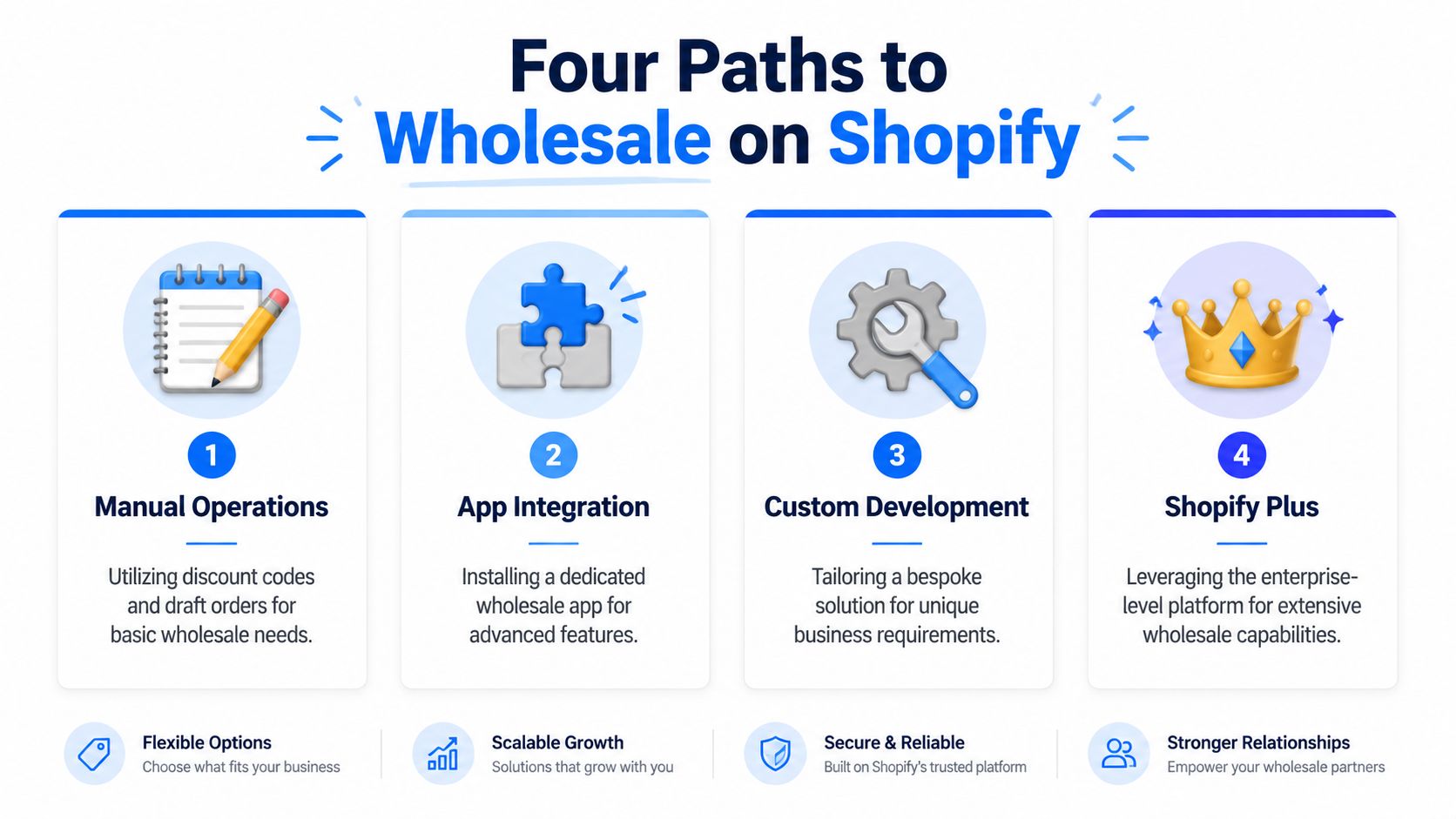
If you only have a handful of wholesale buyers and each order still involves negotiation, manual operations can be enough. That usually means draft orders, invoice-style handling, and carefully controlled discount logic. It's fine for proving demand. It's not fine for scale because your team becomes the workflow.
App-based wholesale is the most common next step. This route makes sense when you need gated pricing, faster reorders, account approvals, and less admin work, but you still don't need enterprise-level account structures. For many small and mid-sized merchants, this is the practical middle ground.
Custom development fits merchants with unusual requirements. That might be specialized catalogs, non-standard buyer flows, unusual ERP dependencies, or a brand experience that off-the-shelf apps can't handle cleanly. This path can work well, but only if you already know your process well enough to design around it.
Shopify Plus B2B becomes attractive when wholesale is no longer an add-on and starts acting like a real business unit. Shopify's native B2B includes company accounts, role-based permissions, customer-scoped catalogs, price lists, net payment terms, and B2B checkout controls, as discussed in this breakdown of Shopify wholesale account options.
Shopify wholesale methods compared
| Method | Best For | Typical Cost | Key Limitation |
|---|---|---|---|
| Manual operations | Early-stage brands with a few wholesale accounts | Low software cost, high team time | Breaks when order volume or account complexity grows |
| Wholesale app | Small and mid-sized brands that need structured B2B features | Monthly app spend plus setup time | Can become awkward if workflows get highly complex |
| Custom development | Brands with non-standard wholesale requirements | Variable build and maintenance cost | Requires clear specs and ongoing technical ownership |
| Shopify Plus B2B | Merchants running wholesale as a serious channel with buyer hierarchies and account rules | Plus-level platform cost | Can be more than you need if your B2B process is still simple |
When Shopify Plus B2B is the better choice
Most guides stop at “apps are cheaper, Plus is more powerful.” That's not enough to make the decision.
Choose the app route if your needs are mostly about restricted pricing, easy ordering, and customer approval. If one buyer equals one login, if your payment terms are simple, and if your catalog doesn't need heavy account-specific logic, an app is usually sufficient.
Choose Plus when the friction is operational, not cosmetic. The signs are familiar:
- Your buyers aren't single users: You need company accounts with multiple contacts or roles.
- Catalog access varies by account: Different buyers should see different products or price lists.
- Terms matter: Net payment terms are part of the normal buying process.
- Your team keeps patching exceptions: Workarounds are eating time every week.
Wholesale gets expensive when your team has to remember exceptions. The right setup removes memory from the process.
A separate storefront still has a place, especially when retail and wholesale need very different merchandising, content, or customer journeys. But it creates overhead. You'll manage more than one environment, and merchandising discipline has to stay tight. For most brands, that should be a deliberate choice, not the default.
Setting Up Your B2B Customer Experience
A wholesale buyer gets approved on Monday, logs in on Tuesday, and still sees retail pricing or products they should not access. That is how a promising account starts with doubt instead of confidence.
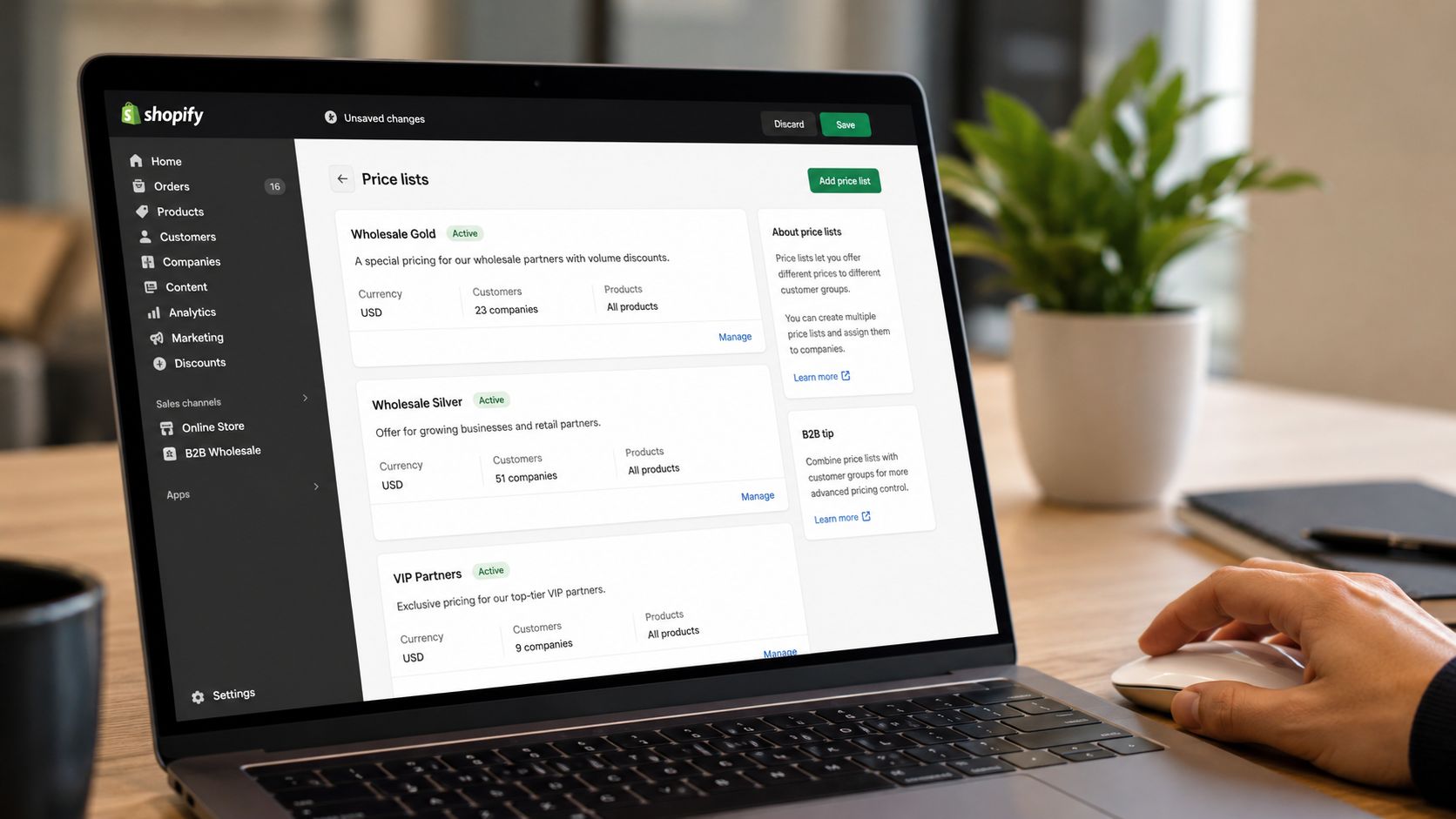
The setup that prevents this is simple to describe and easy to get wrong. Build the experience around account approval, account state, and clear buying rules. Do not build it around loose discount codes or hidden collections alone.
Build access around approval, not around discounts
For smaller brands using an app-based setup, a tagged customer model is usually the cleanest starting point. A lead applies, your team reviews the account, you approve it, and the account gets the tags or permissions that control product access, pricing, and checkout options. It is not glamorous, but it is reliable.
The application form should qualify the buyer and help operations, not just collect emails. Ask for business name, website, resale or tax details if needed, shipping region, product interest, and anything your team uses to approve terms. If sales has to chase basic account information after approval, the process is already slower than it should be.
Tagging rules also need discipline. I have seen stores where three people created three versions of the same account status, and support had no idea which rule controlled pricing.
A practical structure might include:
- Wholesale approved for portal access
- Wholesale domestic for region-specific shipping or catalog rules
- Wholesale net terms for payment eligibility
- Wholesale VIP for a separate price list or restricted products
If your operation is getting more complex, move from loose tags to stricter account structures as soon as possible. That is one of the clearest signs you are outgrowing a basic app setup.
Configure the buying experience buyers actually need
Wholesale buyers usually care less about browsing and more about speed, clarity, and confidence. They want to log in, find SKUs fast, confirm pack sizes, see the right price, and place an order without emailing your team to check the rules.
That means your setup should cover four things before any buyer goes live:
- Catalog visibility so retail shoppers do not land on wholesale-only products, bundles, or case packs.
- Account-based pricing so approved buyers see the correct prices across product pages, cart, and checkout.
- Checkout rules so each account only sees the payment methods and terms they are allowed to use.
- Order controls such as minimums, case-pack requirements, and quantity increments.
This is also where brands with both retail and wholesale can create friction for themselves. The experiences should differ, but the brand logic should still match across channels. A buyer should not get one set of expectations in email, another on the site, and a third from customer service. Good omnichannel customer experience planning helps prevent that drift.
Keep the interface plain if needed. Plain is fine. Confusing is expensive.
Match the setup to your stage
This is the decision point many guides skip.
If you are early in wholesale and only need approved accounts, hidden pricing, and a straightforward order flow, keep the customer experience lightweight. Use a good application form, clear account approval rules, and simple catalog controls. That works well for brands testing demand or serving a modest number of stockists.
If buyers need account-specific catalogs, multiple contacts per company, or different ordering rules by region or channel, design the experience around those realities from the start. Trying to fake account structure with patches usually creates support issues, pricing mistakes, and edge cases at checkout.
A separate wholesale storefront can still make sense when the catalog, content, and ordering behavior are materially different from retail. If you go that route, inventory discipline matters. Brands running separate storefronts with overlapping SKUs should plan for unifying inventory for multiple Shopify stores before wholesale orders start competing with retail stock.
Test the full buying path before launch
Do not trust the admin view. Test the live experience with a real approved account.
Check the full path:
- Login and access: Buyers land in the right area without loops, broken redirects, or visible retail-only pages.
- Pricing display: Prices stay correct on collection pages, product pages, cart, and checkout.
- Rule interaction: Discounts, terms, and shipping rules do not combine in ways that create margin problems.
- Order completion: Payment methods, tax handling, shipping options, and confirmation emails all match the approved account type.
A walkthrough helps here if your team hasn't built one before:
The common failure is not that wholesale never launches. It is that one detail slips through. A buyer sees the wrong price. A payment option disappears. A restricted product becomes visible. Those errors are small in admin and costly in front of a new account.
Your Wholesale Pricing and Order Workflow
Pricing is where many wholesale programs either become sustainable or become a constant margin problem. Simpler models usually perform better because your team can explain them, your buyers can understand them, and your operations staff can support them without checking a spreadsheet every time.
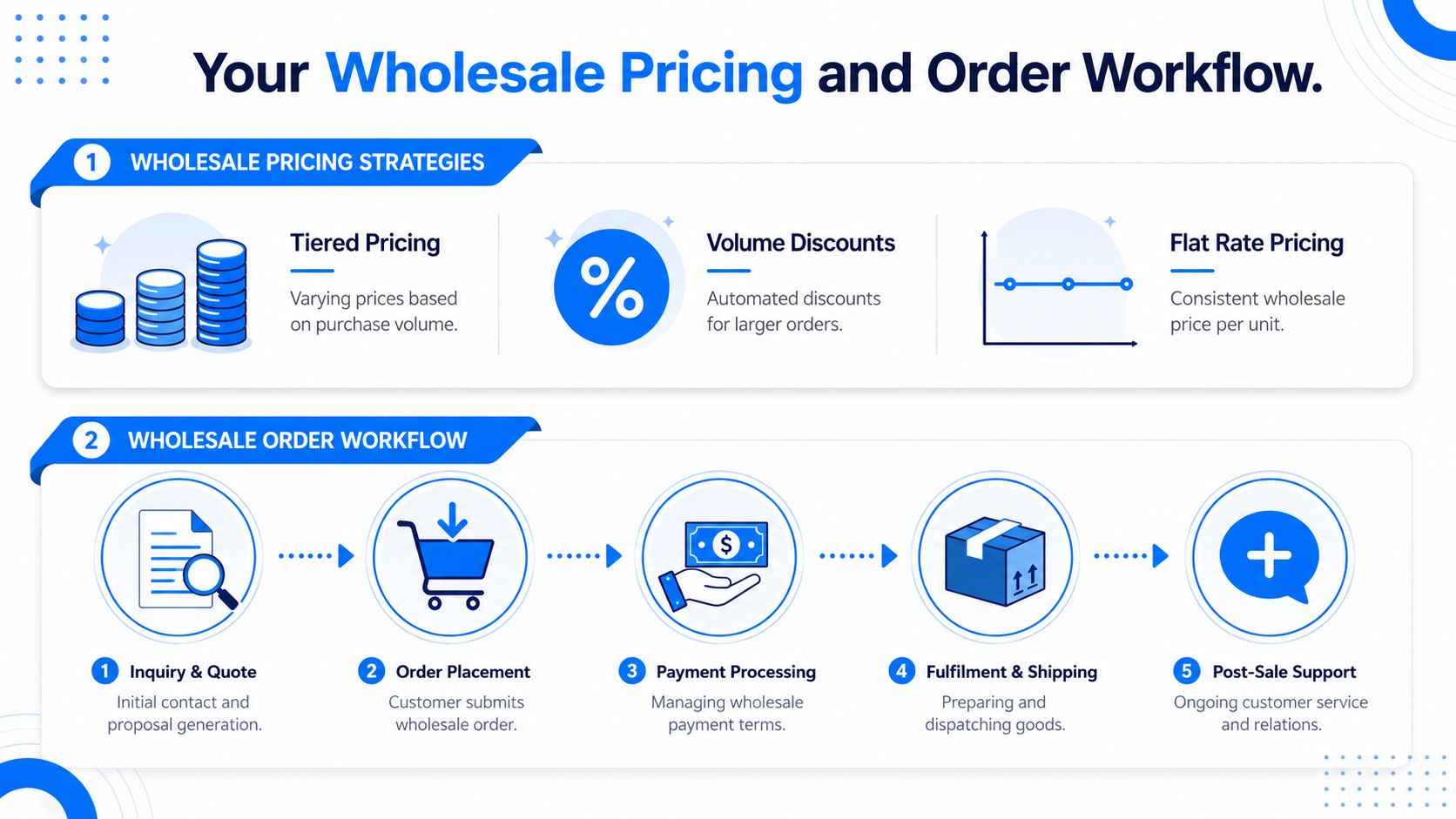
Guidance on Shopify wholesale pricing strongly favors 3–4 tiers, with each tier at least 5% apart and based on historical sales data, and it recommends reviewing pricing quarterly to keep pace with product performance and changing costs, according to Barn2's Shopify wholesale pricing guidance.
Keep pricing simple enough to manage
That guidance matches what works in practice. Overcomplicated discount ladders create more questions than sales.
A useful pricing model often has three moving parts:
- Base logic: Start from cost-plus discipline so every SKU has a defensible floor.
- Tiering: Add a limited set of volume breaks that buyers can understand without a calculator.
- Exceptions: Reserve them for strategic accounts, not for everyone who asks.
If you want a structured way to pressure-test margins before setting account pricing, a wholesale price calculator for Shopify merchants can help frame the decision before rules go live.
Build an order workflow your team can repeat
Wholesale orders involve more operational touchpoints than DTC orders. You're often checking account status, confirming terms, validating pack sizes, and managing different fulfillment expectations.
I like to map the workflow in plain language:
- Inquiry or application comes in and the account gets reviewed.
- Buyer is approved and gains access to the right catalog and terms.
- Order is placed through the portal or through a sales-assisted flow.
- Operations checks exceptions such as special shipping, split fulfillment, or account-specific handling.
- Reorders become easier than the first order, not harder.
If your team has to ask “what do we do with this wholesale order?” more than once, the process isn't finished.
Separate inventory planning is often the hidden issue. A wholesale buyer can absorb stock that your retail side expected to sell over time. That gets harder when brands run more than one storefront or location. If you're dealing with duplicate SKUs across environments, this guide on unifying inventory for multiple Shopify stores is worth reviewing before wholesale volume grows.
Watch the inventory split closely
Many brands don't need a separate physical inventory pool on day one. They do need a policy.
Decide in advance:
- Allocation: Will key wholesale accounts get priority on certain SKUs?
- Lead times: Which products are stocked versus made to order for B2B?
- Shipping rules: Are pallet, freight, or case-level requirements different from retail fulfillment?
- Tax handling: How will exempt buyers be reviewed and maintained?
These rules matter just as much as pricing. A profitable wholesale program isn't just “larger orders.” It's a repeatable workflow that doesn't disrupt the rest of the business every time a buyer places one.
Attracting and Retaining B2B Customers
Good setup doesn't create demand on its own. A wholesale channel grows when buyers can discover it, understand it, and trust that ordering will be easy.
That starts on your existing site. Many Shopify brands bury wholesale behind a footer link or a vague contact page. That wastes intent. If someone lands on your site looking for retail partnership, corporate gifting, or bulk purchasing, they should find a clear path into a wholesale inquiry or application flow.

Make your retail site pull its weight
Create a dedicated wholesale landing page that answers practical questions. Who it's for, product categories, order process, account approval, and contact expectations. Keep the tone commercial, not promotional.
For lead capture, don't rely only on a static form buried on that page. Buyers often browse product pages before they identify themselves. If you want ideas for turning existing traffic into segmented inquiries, these lead magnet examples for ecommerce sites are useful because the underlying principle applies well to wholesale interest capture too.
Outbound works better when the target list is narrow
Outbound fails when brands blast generic wholesale pitches to anyone with a storefront. It works better when the target account list is tight and the outreach reflects actual fit.
Look for retailers, specialty chains, hospitality groups, subscription boxes, or corporate buyers that already sell adjacent products and match your price position. Then write outreach that shows you understand their shelf, audience, or assortment.
Signal-based prospecting can sharpen this process. If your team is building outbound around timely intent, this guide on how to improve B2B pipeline with buying signals is a useful framework for deciding who to contact and when.
Wholesale outreach improves when the message sounds like merchandising, not begging. Lead with fit, reorder logic, and buyer usefulness.
Retention comes from operational reliability
A lot of merchants focus heavily on acquisition and then underinvest in reorder experience. That's backward.
B2B retention usually comes from very practical habits:
- Fast reorder access: Buyers shouldn't need to dig through your site every time.
- Clear communication: Terms, shipping windows, and stock expectations should be obvious.
- Account memory: Know what each buyer typically orders and where friction has appeared before.
- Relevant email cadence: Send restock reminders, seasonal ordering prompts, and product updates that matter to accounts.
The strongest wholesale relationships often feel boring in the best possible way. Orders go through cleanly. Inventory expectations are realistic. Questions get answered. Nothing surprises the buyer unless it helps them.
Key Habits for a Profitable Wholesale Program
A wholesale program usually becomes profitable or painful for the same reason. The operating rules are either clear and repeatable, or they live in someone's inbox and get reinvented on every order.
The Shopify stores that handle wholesale well tend to share the same habits. They keep the model simple enough to run, strict enough to protect margin, and documented enough that a team member can step in without creating account-by-account chaos.
Here's the checklist I use most often with clients:
- Test every buyer state: Check approved accounts, pending accounts, term-based checkout, shipping outcomes, tax handling, and edge cases before buyers hit them first.
- Separate retail and B2B logic cleanly: Buyers should always know which catalog, pricing, and checkout rules apply to them. Your internal team should know too.
- Keep pricing manageable: If sales reps need to explain the pricing model on every call, the structure is too complex.
- Document account rules: Approval criteria, payment terms, MOQ policies, shipping exceptions, and discount authority should sit in one operating document.
- Measure wholesale on its own economics: Review margin, reorder rate, support load, and payment risk separately from DTC.
- Protect the second order: The first order shows interest. The second order shows the account can become predictable revenue.
Margin discipline matters here. Large POs can hide weak economics if freight, payment terms, rep time, and small exceptions chip away at profit. I usually advise merchants to set floor margins by product line and decide in advance which accounts can earn exceptions. If every promising buyer gets a custom deal, wholesale stops behaving like a channel and starts behaving like custom project work.
This is also where business stage matters. Smaller brands usually win by keeping wholesale policies tight, limiting custom pricing, and avoiding tools they will not fully use. Larger teams with sales reps, negotiated terms, and more complex catalogs can justify more layered workflows, but only if they review profitability at the account level and clean up rule sprawl regularly.
The best wholesale operators stay boring on purpose. Orders are easy to place, pricing is predictable, exceptions are rare, and the team knows exactly how to handle common issues. That consistency is what keeps buyers reordering and keeps the channel worth running.
