
A retail buyer finally replies to your outreach. They like your product, they want line-sheet details, and then they ask the question that stops a lot of Shopify founders cold: What's your wholesale price?
If you guess, you create problems in both directions. Price too low and you train yourself to celebrate orders that quietly lose money. Price too high and the buyer can't make the margin they need, so the conversation stalls even if they love the product. That's why a wholesale price calculator matters. It's not just a way to do math. It's how you decide whether wholesale will strengthen your business or drain it.
The good news is that this isn't mysterious. Wholesale pricing has always been structured work, long before apps and spreadsheets. The Smithsonian preserves a 9.5-inch paper linear slide rule used by General Foods to calculate retail pricing, a reminder that brands have been using formal pricing tools for a long time because profitability depends on them, as shown in the Smithsonian record for the General Foods pricing slide rule.
Table of Contents
- Why Just Winging It on Wholesale Pricing Is a Mistake
- The Building Blocks of Your Product Cost
- Choosing Your Pricing Formula Markup vs Margin
- Real-World Examples and Industry Benchmarks
- From Calculation to Strategy for Shopify Merchants
- Protecting Your Profits in a Volatile Market
Why Just Winging It on Wholesale Pricing Is a Mistake
A lot of founders start with a retail price they “feel good about,” then cut it down for wholesale and hope it works. That approach feels fast, but it usually creates one of two bad outcomes. Either the brand underprices and can't support reorder volume, or it sets a wholesale number that leaves no room for a retailer to stock it confidently.
The problem gets worse on Shopify because your pricing has to do more than land one account. It has to support your store, your future promotions, your email offers, your bundles, and your B2B conversations. If the underlying wholesale number is wrong, every other pricing decision gets harder.
Wholesale buyers don't buy your enthusiasm
Retail buyers are looking at your product through a resale lens. They want to know whether your price lets them maintain a healthy shelf strategy. They also want confidence that you understand your own numbers. A founder who says, “I usually sell it for this, so I guess wholesale would be around half,” sounds unprepared.
A wholesale price should come from a system, not a mood.
That doesn't mean your calculator has to be complicated. It does mean you need a repeatable method that starts from actual product cost and then connects to how the item will perform in stores.
Guessing creates hidden damage
The biggest pricing mistakes usually don't show up on the first order. They show up later.
- Reorders become painful: You win the account, but each reorder exposes thin margins you can't fix without a difficult price increase.
- Promotions start eating margin: Your direct-to-consumer calendar looks active, but discounts push you below a safe floor.
- Retail relationships get shaky: Stockists don't like finding your products promoted in ways that undercut them.
- Cash gets trapped: You're moving units, but not generating enough contribution to fund inventory, packaging upgrades, or paid acquisition.
A solid wholesale price calculator fixes this by turning one vague question into a sequence: what the unit costs, what margin you need, what price a retailer can accept, and what retail price your own store must protect.
The Building Blocks of Your Product Cost
If your inputs are wrong, your wholesale price calculator will still give you an answer. It'll just be the wrong answer with spreadsheet confidence.
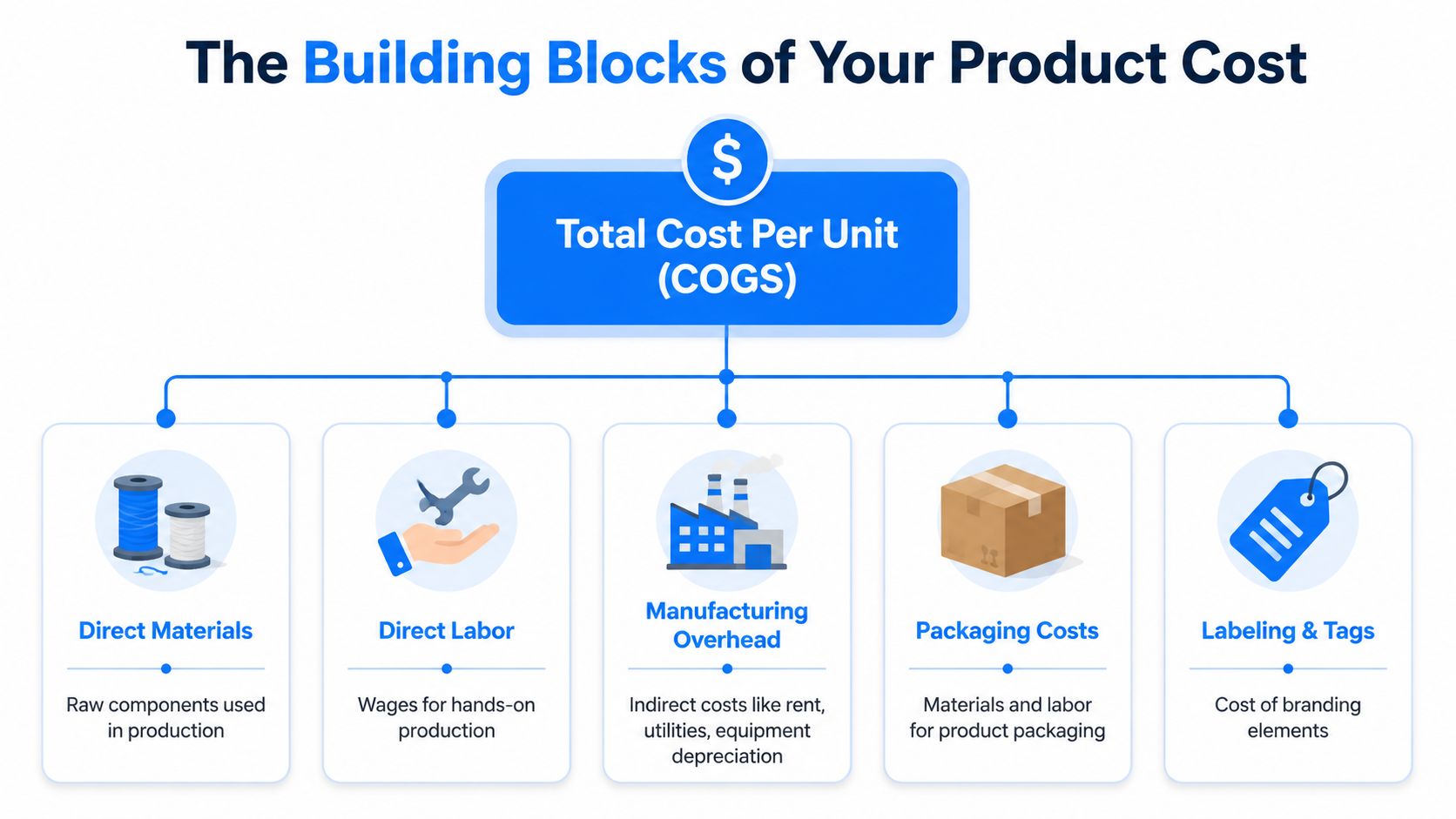
Most brands need a simple discipline here. Calculate total cost per unit using the same categories every time. A standard cost-plus model adds materials, labor, packaging, and overhead. One worked example shows how an $8.50 manufacturing cost plus 15% overhead becomes $9.78 before markup, as illustrated in this wholesale price calculator example.
What belongs in total cost per unit
For most Shopify brands, these are the core cost buckets that matter:
- Direct materials: The raw inputs that physically become the product. For a candle, that might be wax, fragrance oil, wick, and vessel. For apparel, it could be the blank garment, ink, and neck label.
- Direct labor: The hands-on work to make, assemble, print, pour, prep, or pack the item. If you make the product yourself, your time still counts.
- Packaging costs: Product boxes, protective wrap, inserts, sleeves, jars, mail-safe packing pieces, and any labor tied to packing.
- Allocated overhead: The indirect costs your product depends on, such as rent, software, equipment use, utilities, and production space costs.
- Labeling and tags: Barcodes, hang tags, compliance labels, ingredient labels, care tags, or branded stickers.
Practical rule: If the product can't be made, packed, or prepared for sale without the expense, it belongs in your unit cost somewhere.
The costs founders forget
Underpricing typically stems from a common oversight. Founders often remember ingredients and packaging but skip the less visible costs that still hit cash.
A few common misses:
Your own labor
Many early-stage brands act like owner time is free. It isn't. If you don't count it now, your wholesale model breaks the moment you need help.Packaging labor
The box itself gets counted. The time to fold it, fill it, label it, and prep it often doesn't.Software and operating overhead
Inventory systems, design tools, order management apps, and workspace costs all affect profitability. If you're tightening your pricing model, it also helps to review understanding inventory's impact on cashflow, because stock valuation and cash timing can change how healthy your margins look in practice.Small compliance costs
Tags, labels, inserts, and minor finishing touches feel negligible until you multiply them across a production run.
If you want a second lens on how cost and margin interact inside Shopify economics, this guide to a Shopify profit margin calculator is useful for checking whether your unit assumptions hold up once the product is live.
A practical worksheet for one SKU should answer one question cleanly: what does one sellable unit cost before markup or margin goals enter the picture? If you can't answer that quickly, don't set a wholesale price yet.
Choosing Your Pricing Formula Markup vs Margin
This is the point where many founders get tripped up. They say “margin” when they mean “markup,” use the wrong formula, and end up with a price that looks profitable on paper but isn't aligned with how wholesale works.
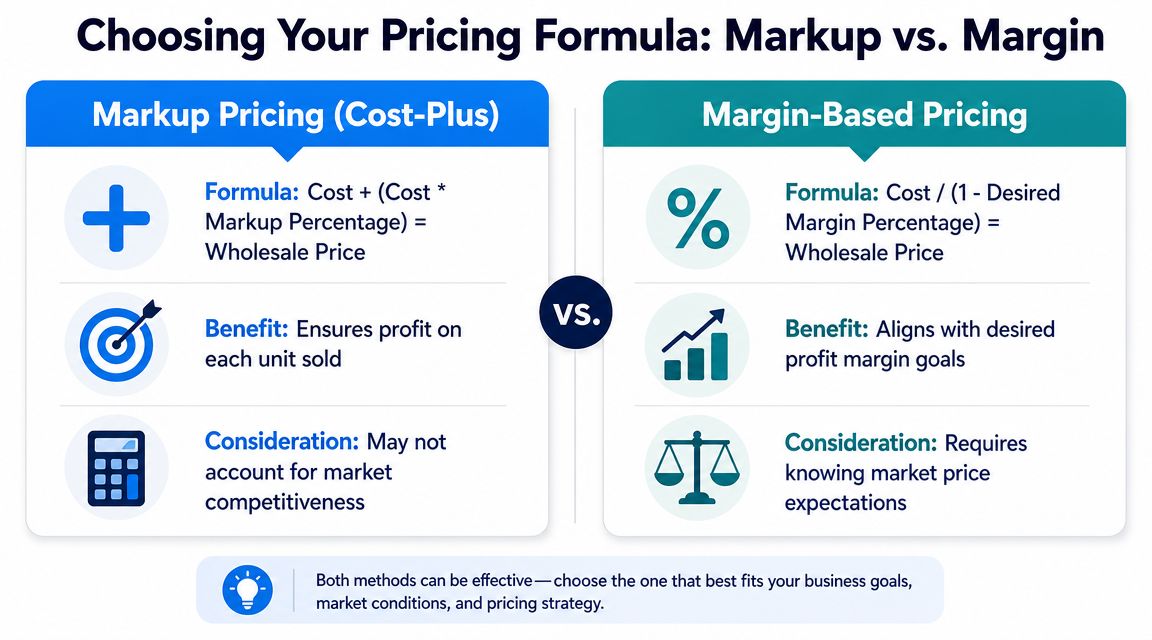
Many guides blur the difference. They shouldn't. A brand usually has to choose between Cost × (1 + Markup%) and Cost / (1 - Profit Margin), and that choice changes both the final price and the room left for retail partners, as explained in this guide on markup and margin in wholesale pricing.
Two formulas that sound similar but aren't
Markup pricing starts with cost and adds a percentage on top.
Formula: Wholesale Price = Total Cost × (1 + Markup %)
This is often the easier method for newer brands because it's straightforward. If your product costs you a certain amount, you add your desired markup and get a wholesale number.
Margin-based pricing starts with the profit share you want the final selling price to contain.
Formula: Wholesale Price = Total Cost / (1 – Target Margin %)
This method is useful when you're working backward from a target profitability level and need tighter control over the economics of each unit sold.
A side by side comparison
Here's the cleanest way to see the difference. Use a product with a $10 total cost per unit.
| Method | Formula | Result |
|---|---|---|
| 50% markup | $10 × 1.50 | $15 wholesale price |
| 50% margin | $10 / 0.50 | $20 wholesale price |
Same cost. Same percentage word. Very different answer.
That's why founders who say “I want a 50% margin” but use markup math often underprice without realizing it.
Margin is a share of the final price. Markup is an addition to cost.
Which one works better
There isn't one universal winner. It depends on how you make pricing decisions.
Use markup when:
- You need speed: You're building first-pass pricing for a product line and want a simple consistent method.
- Your costs are stable: You have reliable production inputs and want a predictable rule.
- You're testing assortment: You want to see whether a category can survive wholesale before fine-tuning.
Use margin-based pricing when:
- You need a profit floor: You know the minimum profit share each unit must contribute.
- You're planning around channel complexity: Distributor layers, retailer expectations, or promo strategy make pricing tighter.
- You already know market constraints: You have a strong view of acceptable shelf pricing and need to reverse-engineer from it.
What doesn't work is mixing the language casually. If your team says markup in one meeting and margin in the next, you'll make inconsistent decisions. Pick one method for your calculator, document it, and use it the same way across SKUs.
Real-World Examples and Industry Benchmarks
Pricing gets easier when you stop thinking in abstract percentages and start thinking in actual products. A shirt, a candle, and a sauce don't carry the same cost structure, but the discipline is the same. Start with complete unit cost, apply your pricing method, then compare the output against what retail partners can realistically support.
Industry guides often use keystone pricing as a benchmark, with retail at 2x wholesale, and some examples place wholesale around 2 to 2.5 times production cost, which is why it's smart to compare your calculator output against market expectations before locking pricing, as noted in this overview of key wholesale pricing methods and examples.

Example one screen printed t shirt
A screen-printed tee usually has a cost stack that looks manageable at first, then grows once you add the missing parts. The blank shirt is obvious. Ink, print labor, folding, bagging, size stickers, and neck labeling often get missed.
A practical process looks like this:
- Add the blank garment cost.
- Add printing inputs and labor.
- Add packaging and finishing.
- Allocate a share of overhead.
Once you have the true unit cost, apply either markup or margin. Then check whether the resulting wholesale price still leaves room for a retailer to price the shirt credibly on the floor or online.
If the retail price implied by your wholesale number feels out of step with your category, don't force the buyer to solve that problem for you. Revisit product design, packaging, or production efficiency first.
Example two handmade soy candle
Candles are a classic margin trap because brands count wax and vessel but ignore the operational details. Fragrance, wick, warning labels, curing time, boxing, and breakage allowance all matter.
For candles, I usually see founders benefit from a stricter cost sheet because small omissions add up fast. A jar upgrade or label change can shift the economics enough to make an old wholesale price stale.
If a product is fragile, handmade, or compliance-heavy, build the calculator with more detail than you think you need.
A useful benchmark check for candles is shelf logic. If your wholesale price leads to a retail number that feels too high for your ingredient story, packaging presentation, or target store type, the issue may not be the formula. The issue may be the product architecture.
Here's a useful walkthrough to reinforce that thinking:
Example three small batch gourmet sauce
Consumables add another layer because packaging, ingredient yield, and case-pack logic matter. A gourmet sauce may look profitable one bottle at a time, but wholesale buyers are thinking in case movement, shelf competition, and repeat purchase behavior.
For a small-batch sauce, your worksheet should reflect:
| Cost area | What to include |
|---|---|
| Ingredients | Every recipe input used per sellable unit |
| Production labor | Cooking, bottling, cleanup, prep time |
| Packaging | Bottle, cap, seal, label, case materials |
| Operational allocation | Shared facility and business overhead |
Then pressure-test the result. If the wholesale number forces the retail shelf price too far beyond comparable products, you may need a smaller bottle, different packaging, or a revised ingredient strategy.
Benchmarks are useful for this reason. They don't replace your calculator, but they stop you from treating the calculator as truth in isolation. The math has to work for you and for the store that needs to resell the item.
From Calculation to Strategy for Shopify Merchants
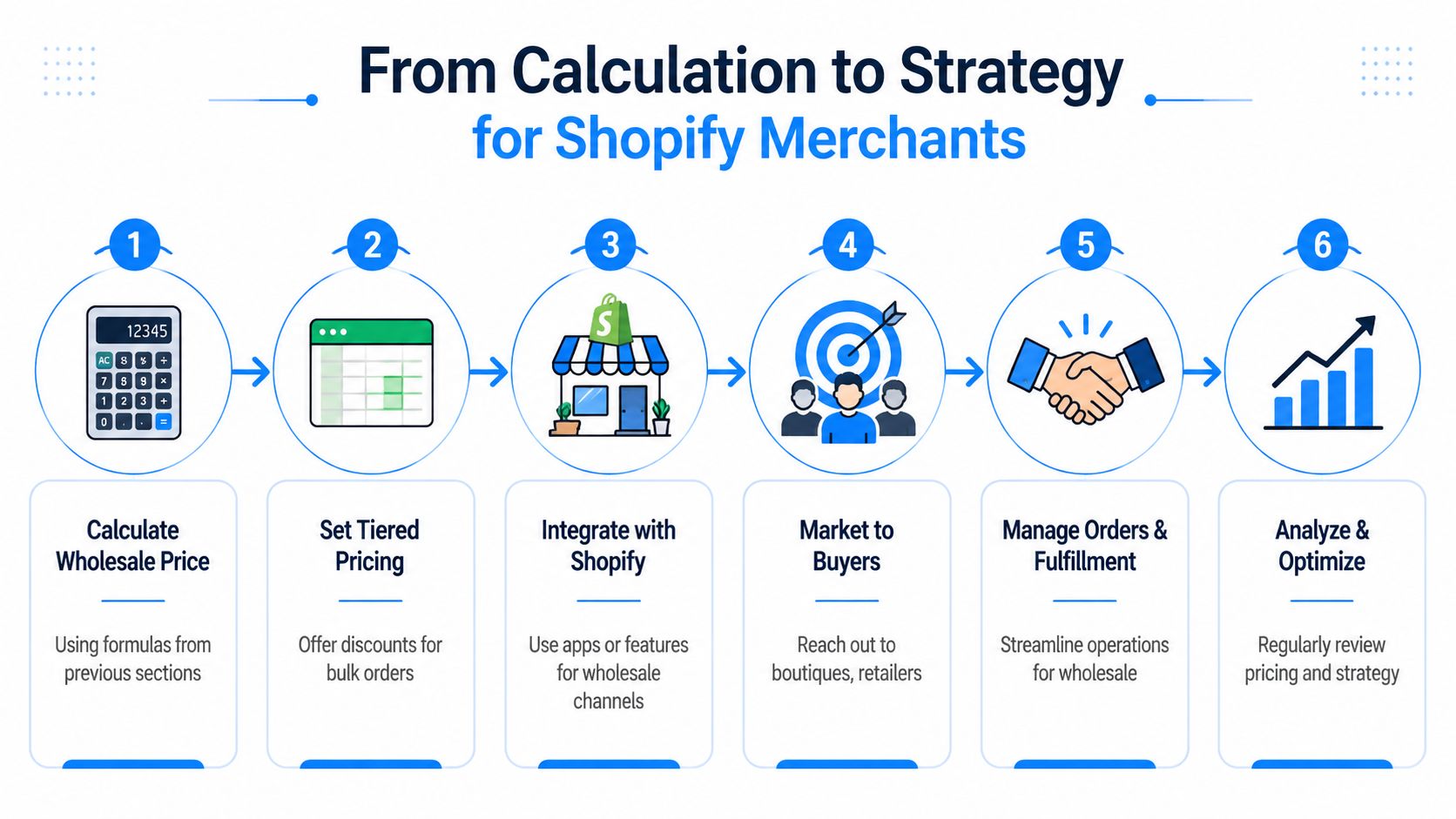
A strong wholesale price doesn't stay inside a spreadsheet. It becomes the reference point for your Shopify pricing system.
That matters because wholesale isn't a separate side project. It affects your MSRP, your sale calendar, your bundle logic, your email promotions, and your conversations with stockists. Business guides that use an absorption pricing workflow also note that wholesalers often target 20–50% profit margins, while retail partners often expect 50–60% margins on top of wholesale, as outlined in this guide to calculating your wholesale price.
Your wholesale price sets your retail guardrails
Many Shopify merchants think of wholesale pricing as something they only need when a buyer asks. In practice, it should shape your direct-to-consumer decisions too.
If your wholesale price is healthy, you can answer tougher questions with more confidence:
- How deep can a sale go? Your wholesale number gives you a floor to evaluate discounting.
- Can this product support bundles? If the bundle price cuts too close to wholesale economics, the offer may drive revenue but weaken the business.
- Are your promotions training bad habits? Frequent discounting below a safe threshold can create channel conflict with retailers.
This is especially important when you're running acquisition campaigns. Your product margin needs to survive not just discounting, but the cost of getting the customer. That's why it helps to keep a separate view of paid traffic economics with a resource on cost per click calculation, so your promo strategy doesn't ignore acquisition reality.
Wholesale price is not just a B2B quote. It's a guardrail for every discount you run on your own store.
Using your price to attract better B2B partners
Once your price is grounded, your wholesale offer becomes easier to present. You can create a cleaner buyer experience with protected wholesale pages, trade application forms, and a line sheet that matches the economics of the business.
A few practical moves work well:
- Create a dedicated wholesale path: Keep trade information separate from the consumer shopping experience so buyers can review terms without confusion.
- Use tiered pricing carefully: Volume incentives can help, but only if each tier still protects contribution.
- Keep MSRP discipline: Buyers want confidence that your direct channel won't constantly undercut them.
- Target stores that fit your price architecture: A boutique, a gift shop, and a specialty grocer don't all evaluate value the same way.
If you're actively looking for stockists, curated discovery can save time. A resource like sign up for retail matchmaking can help brands get in front of buyers in a more structured way than cold outreach alone.
The strategic shift is simple. Stop treating your wholesale price as a quote you send when asked. Treat it as the number that organizes your retail promise, your promo ceiling, and your B2B channel discipline.
Protecting Your Profits in a Volatile Market
A wholesale price calculator is not a one-time setup. It's a maintenance tool.
Many pricing guides stop after the formula, but that's where real margin erosion starts. Current guidance on wholesale calculators points out that most brands treat pricing as static even though landed costs, shipping pressure, and trade uncertainty can make a once-profitable price turn weak over time, as discussed in this article on landed-cost volatility in wholesale pricing.
Review pricing before costs review you
If a supplier changes a component cost, if freight changes, or if packaging shifts, your old worksheet is already outdated. You don't need drama to trigger a review. You need a routine.
Use a simple review discipline:
- Check unit costs regularly: Revisit your cost sheet on a schedule that matches how exposed your business is to supplier or freight changes.
- Update after meaningful input changes: New packaging, revised labor steps, and shipping changes should trigger a recalculation.
- Review promo behavior too: A price can look fine in isolation but fail once discounts and bundles are layered on top.
If you're merchandising products together in Shopify, this matters even more. A product that looks strong alone can become weak in a combo offer, which is why it helps to think through related merchandising mechanics like frequently bought together.
How to handle increases with wholesale accounts
Raising prices is uncomfortable, but silent margin loss is worse. Good wholesale partners don't expect you to absorb every increase forever. They do expect clear communication and consistency.
Keep it practical. Update your cost sheet first. Confirm the new price logic. Then communicate changes with enough lead time for buyers to plan reorders and shelf pricing. Accounts are more receptive when your pricing looks deliberate rather than reactive.
A healthy wholesale business isn't built by finding the perfect price once. It's built by recalculating before small cost shifts become permanent margin leaks.
If you want to turn more Shopify traffic into email subscribers and direct sales without relying on flat, forgettable popups, SmashPops gives you a more engaging option. It uses gamified pop-ups like Spin the Wheel, Scratch Card, and Pick a Gift to help stores collect leads, deliver coupon offers, and support promotional campaigns with clearer conversion data.
