A lot of Shopify merchants still treat frequently bought together as a cosmetic app block. That's a mistake. Product recommendations are one of the clearest revenue levers in ecommerce. Shoppers who engage with a single recommendation see their average order grow by 369%, and non-engagers convert at just 1.02% on average, according to Drip's summary of Barilliance research.
That changes how you should think about the feature. This isn't a “nice to have” upsell widget. It's a system for increasing basket size, improving conversion quality, and making each product page do more work. On Shopify, the stores that get the most from it usually don't stop at app installation. They decide which pairings should come from data, which should be manually merchandised, where the module belongs on the page, and how it should connect to the rest of the conversion flow.
If you're already working on broader ways to improve fashion ecommerce conversion rates, this is one of the most practical places to focus because it sits right at the intersection of merchandising and conversion design.
Table of Contents
- Why Frequently Bought Together Is a Must-Have Revenue Engine
- Choosing Your Recommendation Strategy
- Implementing Bundles and Pairings on Your Shopify Store
- How to A/B Test and Optimize Your Product Pairings
- Key Metrics for Measuring Recommendation Success
- Advanced Strategy Integrating SmashPops for Higher AOV
Why Frequently Bought Together Is a Must-Have Revenue Engine
Product recommendations are already driving a meaningful share of ecommerce revenue. In the analysis cited earlier, recommendation interactions were tied to major lifts in conversion and revenue contribution. For a Shopify merchant, that puts frequently bought together in the same category as pricing, offers, and checkout optimization. It deserves a place in revenue planning because it influences what goes into the cart before the shopper reaches checkout.
The commercial upside is straightforward. A well-built frequently bought together block helps customers complete the purchase they were already trying to make. That matters in categories where the main product has obvious companions: serum plus moisturizer, camera plus memory card, espresso machine plus descaler, leggings plus matching bra.
Shoppers usually know the hero item. They often miss the accessories, refills, or finishing pieces that increase satisfaction and reduce post-purchase regret.
A candle buyer may need a wick trimmer. A shopper adding a dress may want the belt or earrings that complete the outfit. A customer buying a protein shaker may also need extra bottles or a supplement organizer. In fashion, this merchandising layer can also support styling-led conversion work. Brands looking to improve fashion ecommerce conversion rates often get better results when they pair outfit-building recommendations with stronger on-site engagement.
Practical rule: If the add-on makes the main product easier to use, more effective, or more complete, it belongs in the set.
Execution decides whether this becomes real revenue or just another widget. Stores that plaster low-fit suggestions across every PDP train shoppers to ignore the module. Stores that match recommendations to genuine purchase intent see higher attach rates, better AOV, and fewer abandoned sessions caused by extra searching.
On Shopify, I usually see three profit levers inside a good frequently bought together setup: stronger cart composition, faster decision-making, and better merchandising coverage for high-margin add-ons. The trade-off is control. Automated pairings can surface combinations your team would never spot, but they also need oversight. Manual pairings protect brand presentation and margin, but they take time to maintain as inventory, seasons, and hero SKUs change.
That is why the strategic layer matters more than the install itself. Frequently bought together works best when you decide which pairings should come from order data, which should be hand-picked, and how those recommendations will connect with engagement tools like SmashPops to push the shopper from interest to action. That combination turns a simple recommendation block into a system for raising AOV.
Choosing Your Recommendation Strategy
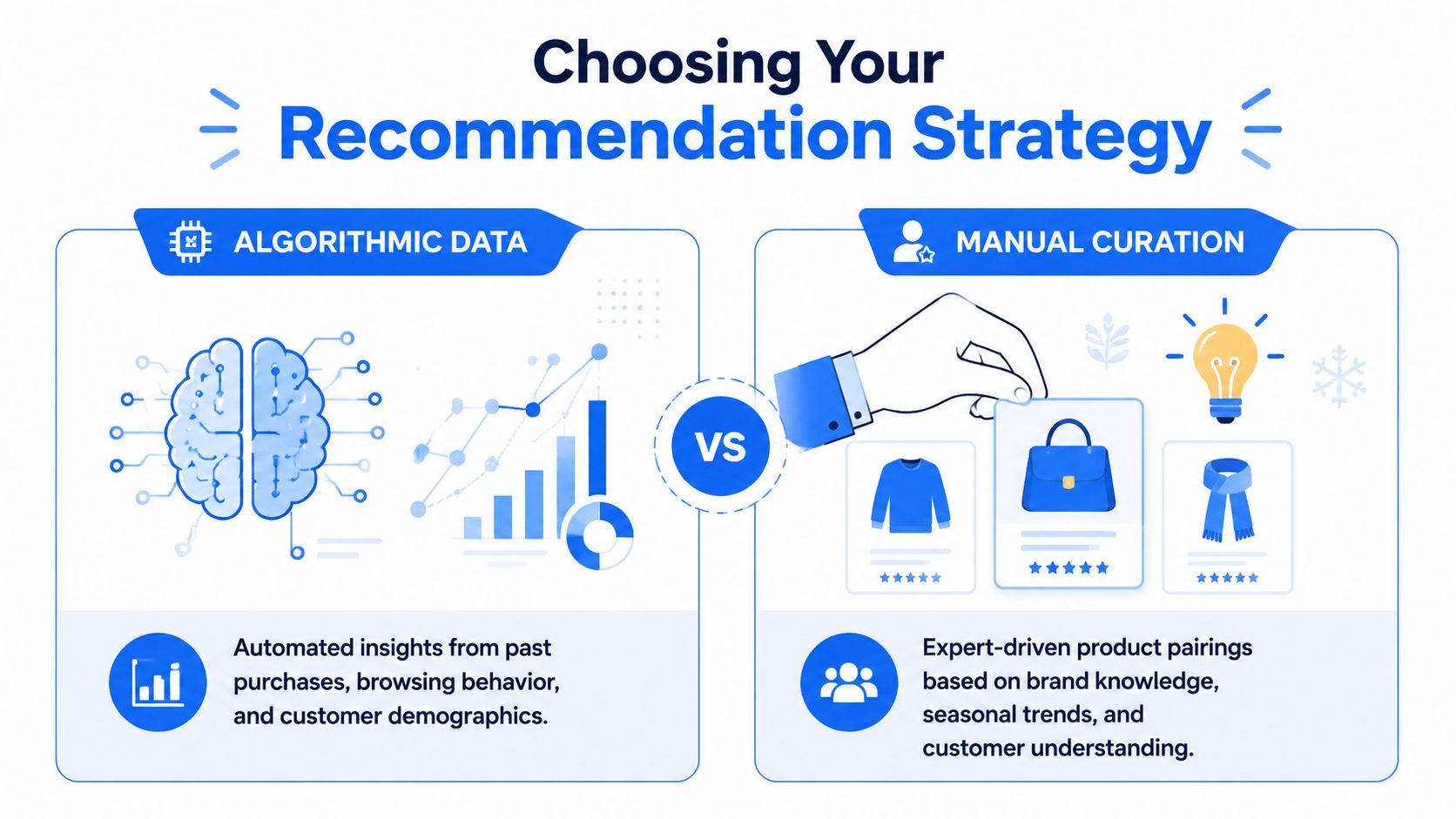
Every frequently bought together setup starts with one decision. Will you let behavioral data decide the pairings, will you curate them manually, or will you combine both?
When algorithms outperform humans
Amazon-style systems typically use item-to-item collaborative filtering or market-basket analysis. In plain English, they look at what people bought together and what they viewed in the same browsing journey, then infer which products belong in the same bundle. Some systems also refresh recommendations every 48 hours, as described in this guide to how Amazon-style frequently bought together algorithms work.
That approach is useful when your catalog has enough order volume across repeatable patterns. It can spot combinations your team might miss.
A Shopify example: if customers repeatedly buy a water bottle with a cleaning brush and a straw cap, the algorithm will usually surface that trio faster than a merchandiser reviewing products one by one.
When manual curation wins
Algorithms have a blind spot. They can only learn from what already happened. That means basket-model recommendations can reinforce what was previously purchased together and miss products that are logical complements but not yet statistically frequent, especially for new launches and long-tail catalogs, as noted in Bloomreach's frequently bought together documentation.
That matters more than most merchants think.
If you launch a new linen blazer, your store data may not yet connect it with the matching trousers, belt, and loafers. A human merchandiser can. The same goes for bundles built around margin goals, excess stock, gift sets, or seasonal stories.
Manual curation is also stronger when:
- You're launching new products and there's no behavioral history yet
- Your catalog is style-led and pairings depend on taste, not just co-purchase data
- You need inventory control because one accessory is overstocked
- You want campaign alignment around holiday, back-to-school, or gifting themes
Good merchandising often beats raw data when the store is changing faster than the algorithm can learn.
The hybrid model that works on Shopify
For most Shopify brands, hybrid is the strongest option.
Use algorithmic recommendations on stable, high-volume SKUs. Use manual pairings on hero products, new arrivals, bundles tied to promotions, and categories where aesthetic judgment matters. Then review the output regularly instead of assuming the app knows best forever.
A simple decision table helps:
| Store condition | Best approach |
|---|---|
| Established bestsellers with strong order history | Algorithmic |
| New collection drop | Manual |
| Long-tail catalog with sparse order data | Manual or hybrid |
| Fast-moving replenishment products | Algorithmic |
| High-margin strategic bundles | Manual |
| Large catalog with merch oversight | Hybrid |
The mistake is choosing sides like this is a philosophy debate. It's an operations question. If the algorithm has enough signal, let it work. If it doesn't, take control.
Implementing Bundles and Pairings on Your Shopify Store
Execution is where frequently bought together either prints money or underperforms. The widget can have good logic and still fail because the app is rigid, the design is clumsy, or the placement asks the customer to do too much thinking.
What to look for in a Shopify app
Start with app selection, but don't choose based on screenshots alone. Choose based on control.
The app should support algorithmic recommendations, manual overrides, design customization, variant handling, and bundle-style add-to-cart behavior. If it can't handle size, color, or product-option logic cleanly, your conversion rate will suffer because customers will hit friction before checkout.
A solid evaluation checklist looks like this:
- Manual override capability so you can force strategic pairings on hero SKUs
- Variant support for products like apparel, cosmetics shades, or multi-size accessories
- Bundle add-to-cart flow that lets the shopper add the whole set without separate clicks
- Theme flexibility so the block looks native to your PDP
- Performance discipline because a slow widget can hurt the page it's meant to improve
If you're building more complex offer structures beyond simple recommendations, this Shopify Plus bundle app guide from Grumspot is a useful reference for thinking through bundle architecture before you commit to a tool.
How to place the widget so people use it
Placement changes outcomes. A frequently bought together block buried under reviews won't do much. Neither will one that appears before the shopper understands the main product.
In most Shopify themes, the strongest position is close to the product form. That keeps the recommendation near the moment where intent is highest. The second useful position is inside the cart or drawer cart, where the customer is already evaluating order completeness.
Here's the practical layout blueprint I'd use on a product page:
- Main product media and core details
- Variant selection
- Primary add-to-cart area
- Frequently bought together module with clear combined selection
- Trust elements, reviews, and longer-form content
The module itself should be simple. Show the main product plus two or three logical companions. Include thumbnails, pricing visibility, variant selectors if needed, and one obvious CTA such as “Add selected items.”
The best widget design reduces decisions. It shouldn't ask customers to decode how the offer works.
A useful implementation walkthrough is below.
How to test implementation without muddy data
Don't roll out three changes at once and call it optimization. If you change the app, the placement, and the offer copy in the same week, you won't know what caused the result.
Use a control-versus-variant approach:
| Test element | Control | Variant |
|---|---|---|
| Placement | Below product description | Near add-to-cart |
| Pairing source | Algorithmic | Manual curated |
| CTA format | Add each item separately | Add selected items |
| Product count | Two-item set | Three-item set |
Run one clean test at a time. If you're also layering promotional logic, pair the recommendation with a specific offer path such as Buy X Get Y discount setup on Shopify rather than improvising discounts in multiple places.
That's how you learn whether the widget itself is strong, or whether the lift only happens when a pricing incentive compensates for a weak pairing.
How to A/B Test and Optimize Your Product Pairings
Most stores don't have a frequently bought together problem. They have a testing problem. They install a recommendation app, glance at a few orders, and decide it's working or not working based on vibes.
That's not enough. The feature needs a disciplined test plan.
Start with one clean hypothesis
A good A/B test isolates one variable. That means you don't compare a manually curated bundle in a new page position with different copy and a discount attached. You compare one meaningful change against a stable control.
Useful hypotheses include:
- Manual vs algorithmic. Does a merchandised pairing beat the app's default output on hero SKUs?
- Two items vs three items. Does the shorter set reduce hesitation?
- PDP placement vs cart placement. Does the shopper respond better before or after adding the primary product?
- Plain recommendation vs offer-supported recommendation. Does the bundle need an incentive to move?
If you want a broader framework for running disciplined experiments, this guide to product strategy for founders using A/B testing is a strong companion read because it keeps the focus on decision quality, not testing for the sake of testing.
The KPIs that actually diagnose performance
You don't need a complicated dashboard to start. You need the right few numbers and a consistent review habit.
Track these on every test:
- Widget click-through rate. Are shoppers engaging with the module at all?
- Add-to-cart rate from recommendations. Are the recommended products making it into the basket?
- Recommendation-influenced AOV. Are orders touched by the widget larger than comparable orders without it?
- Attachment rate. How often does the main product leave the store with at least one paired product?
For stores that want a different testing workflow from standard split tests, it's worth reviewing this A/B testing alternative for Shopify teams because some merchandising decisions are better handled through controlled rollout and segmented comparison.
What to change when results are weak
Weak results usually come from one of three issues.
First, the pairing lacks relevance. The customer doesn't see why the extra product belongs with the primary item.
Second, the placement is late or invisible. A good recommendation hidden low on the page still loses.
Third, the UI asks for too much work. If the shopper has to choose multiple variants across several product cards before clicking, the module becomes a chore.
Test the recommendation logic before you blame the concept. Frequently bought together fails more often from bad execution than from shopper resistance.
When a setup underperforms, simplify before you expand. Fewer products. Cleaner copy. Better placement. Stronger pair logic.
Key Metrics for Measuring Recommendation Success
A frequently bought together widget can look busy and still do very little. Measurement is what separates surface activity from real commercial value.
A simple journey that shows what good measurement looks like
Take a common Shopify flow. A shopper lands on a product page for a reusable coffee tumbler. They select the color, notice a frequently bought together module offering a straw lid and cleaning brush, and add one extra item. Later, in the cart, a popup reminds them of a limited-time offer tied to the bundle, and they complete checkout.
A weak reporting setup would only record the final order value.
A good setup asks better questions. Did the shopper click the recommendation? Which item got attached? Did the order value increase compared with similar tumbler orders? Did the recommendation contribute before the popup appeared, or did the popup do all the work?
That's why recommendation reporting should connect merchandising behavior to revenue behavior, not just traffic behavior.
Benchmarks that keep your expectations realistic
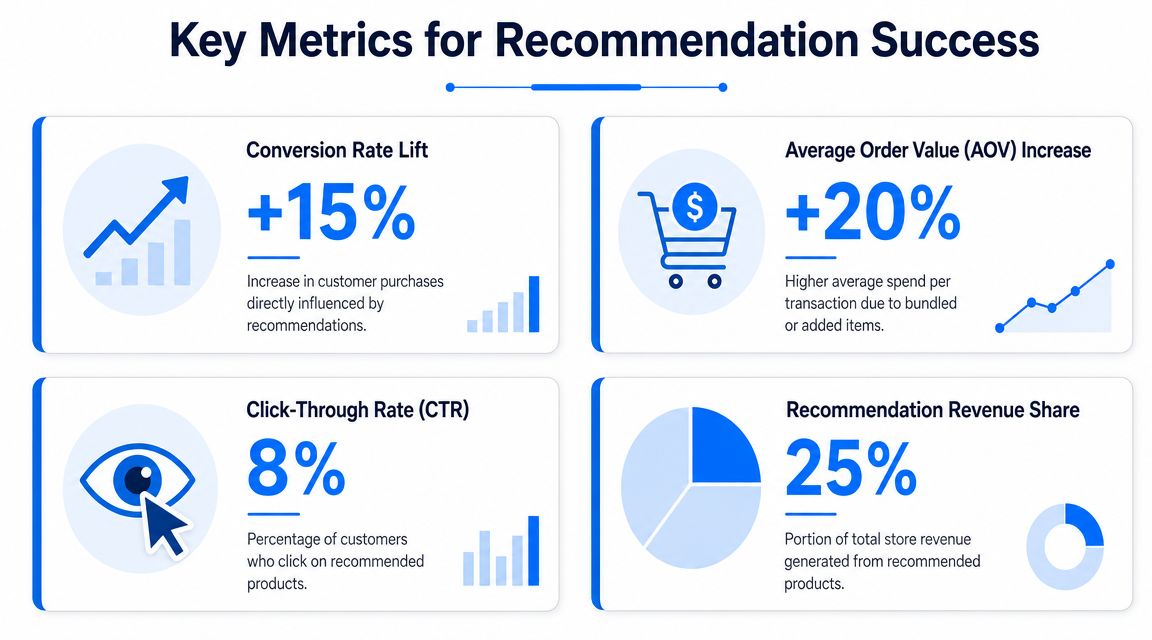
Operational benchmarks for Shopify frequently bought together widgets show that mature catalogs usually need 50+ orders before meaningful patterns emerge and 200+ orders before algorithmic pairings are considered reliable. The same benchmark set reports healthy performance around 3–5% click-through rate and 1–3% add-to-cart rate, according to Growth Suite's benchmark guide for Shopify recommendations.
Those numbers are useful because they keep merchants from overreacting too early. If a new catalog has thin order history, poor algorithmic recommendations don't necessarily mean the concept failed. They may just mean the system doesn't have enough signal yet.
This is also where traffic economics matter. If you're paying for visits, even small improvements in recommendation engagement can change paid acquisition efficiency. A simple refresher on cost per click calculation helps put recommendation performance in context because better basket value changes what each click is worth.
A reporting view worth building
A practical dashboard should include:
- Engagement metrics for the widget itself
- Attachment metrics by primary SKU
- AOV comparison between influenced and non-influenced orders
- Catalog readiness notes so the team knows which products still need manual pairings
- Placement performance if the widget appears in more than one location
You don't need perfect attribution to make good decisions. You need enough clarity to know whether the pairings are relevant, whether customers are interacting with them, and whether those interactions produce larger orders.
Advanced Strategy Integrating SmashPops for Higher AOV
Frequently bought together works best when it isn't isolated. On its own, it creates the upsell opportunity. Combined with a strong engagement layer, it can recover hesitation at the moment the shopper is about to leave.
Where the extra lift comes from
Here's the pattern I'd recommend for a Shopify store.
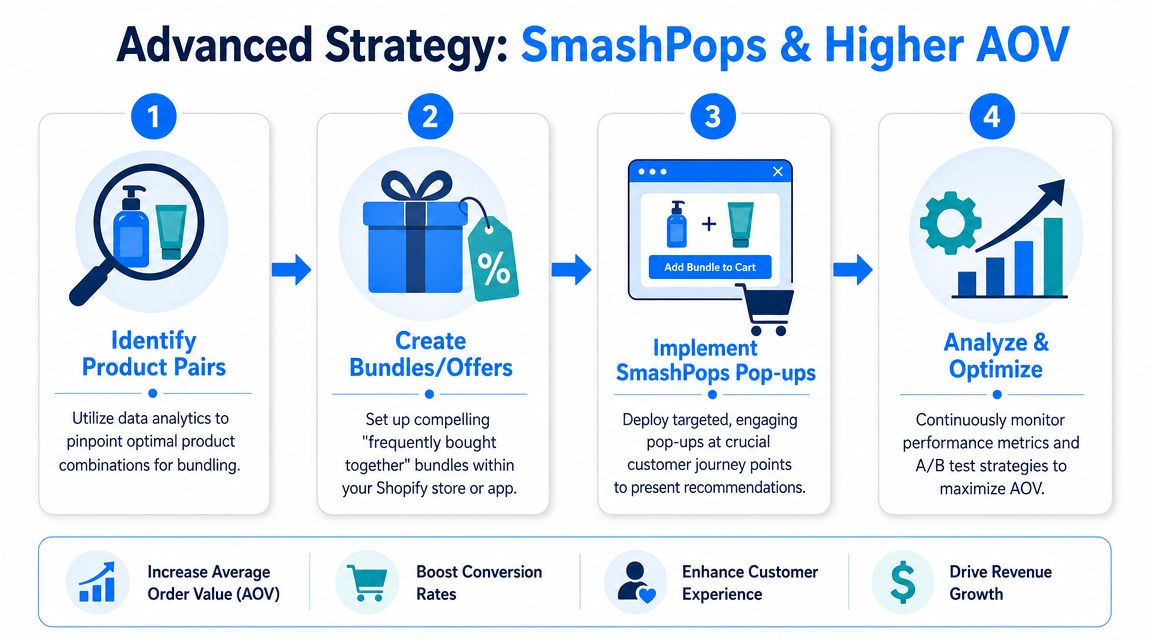
A shopper reaches a PDP, sees a frequently bought together set, and engages with it but doesn't complete the add. That's a high-intent signal. They've shown interest in the bundle logic, but something stopped the action. It might be price sensitivity. It might be distraction. It might be uncertainty about whether they need the full set.
That's where a gamified popup can do a job the recommendation block can't. Instead of showing a generic sitewide offer, trigger a targeted popup on exit intent or similar hesitation behavior and tie the reward to the relevant bundle or order condition. The recommendation built the context. The popup supplies the final nudge.
A recommendation tells the shopper what fits together. A targeted incentive tells them why now.
This only works if the sequencing is disciplined. Don't interrupt too early. Let the product page sell first. Let the bundle logic do its work. Trigger the incentive when the shopper shows signs of leaving or stalling.
The immediate action plan
If you want frequently bought together to become a real AOV system rather than a forgotten widget, the checklist is straightforward.
- Audit your catalog first. Separate high-volume products from new arrivals and long-tail SKUs.
- Choose logic by product type. Use algorithmic pairing where history is strong. Use manual curation where it isn't.
- Fix placement before scaling. Put the module near purchase intent, not buried under supporting content.
- Reduce friction in the UI. Let shoppers add the set cleanly, with clear variant handling and a simple CTA.
- Test one variable at a time. Compare placement, product count, and pairing source with controlled experiments.
- Measure business impact. Track clicks, add-to-cart behavior, attachment, and recommendation-influenced AOV.
- Add an engagement layer. Use triggered messaging to rescue hesitation after the recommendation has already created interest.
A lot of Shopify revenue problems don't come from lack of traffic. They come from leaving intent uncaptured on product pages that should be doing more. Frequently bought together is one of the few tools that improves the order before the customer ever reaches checkout. When you pair strong product logic with thoughtful timing, it becomes far more than cross-sell. It becomes part of how the store sells.
If you want to turn standard popups into a better conversion layer around your product recommendations, SmashPops is built for that job. It lets Shopify stores use gamified popups, targeted triggers, and one-time coupon rewards to capture emails and push more hesitant shoppers into purchase without making the onsite experience feel stale.
