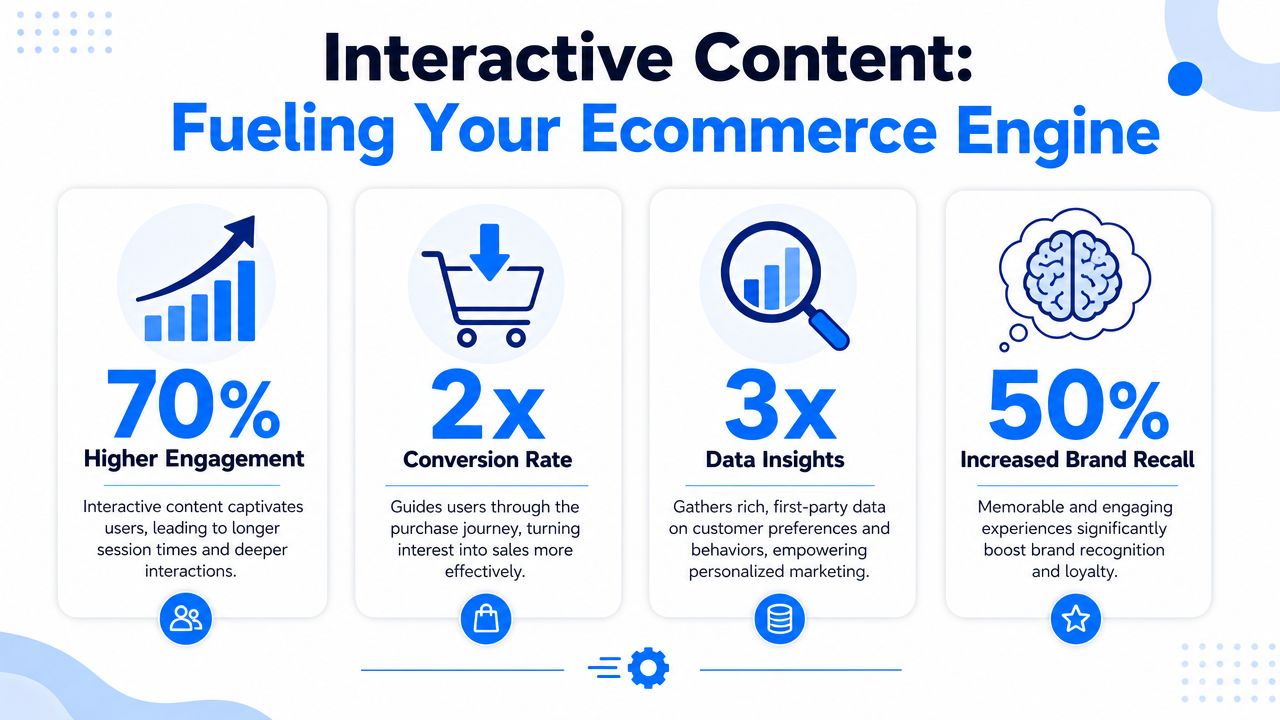
Interactive content can generate 2x more conversions than passive content formats, with estimated gains of 580% for engagement and 1,120% for lead generation according to Reboot Online's content marketing statistics summary. That changes the conversation for ecommerce teams. Interactive content marketing isn't a creative side project anymore. It's a conversion tool.
For Shopify brands, the primary opportunity isn't making content more entertaining. It's using interaction to collect emails, reduce product-selection friction, and recover visitors who were about to leave. A static popup asks for an email and gives a discount. An interactive experience asks the visitor to do one small thing, then rewards that action. That shift matters because participation changes intent.
Most stores don't need more banners, more blog posts, or another generic modal. They need assets that invite a response. If you're trying to boost website engagement with personalization, interactive content works best when it gives people a reason to reveal what they want, not just stare at another offer.
Table of Contents
- From Passive Posts to Active Participation
- What Is Interactive Content Marketing
- Why Interactive Content Drives Ecommerce Growth
- Popular Interactive Formats for Online Stores
- Building Your Interactive Content Strategy
- Interactive Content in Action Ecommerce Examples
- Measuring the ROI of Your Interactive Content
From Passive Posts to Active Participation
Static ecommerce content fails in a familiar way. The popup appears, the visitor closes it. The product grid loads, they skim it. The discount banner sits at the top of the page, and nobody cares. Most stores don't have a traffic problem first. They have an attention problem.
Interactive content marketing fixes that by changing the role of the visitor. Instead of consuming a message, the shopper does something. They answer a question, spin a wheel, choose a preference, calculate a result, or narrow a product set. That one action turns a monologue into a dialogue.
A standard discount popup says, "Give us your email." An interactive version says, "Play, discover, or personalize first." That feels less like interruption and more like exchange. In ecommerce, that difference shows up where it matters: qualified leads, better product discovery, and cleaner paths to purchase.
Interactive content works when the interaction itself helps the shopper make progress, not when it adds friction for its own sake.
Many brands err by adding motion, animation, or novelty and calling it interactivity. That usually burns attention without improving sales. The useful version of interactive content gives the shopper one of three things: guidance, reward, or feedback. If it doesn't do one of those, it's decoration.
What Is Interactive Content Marketing
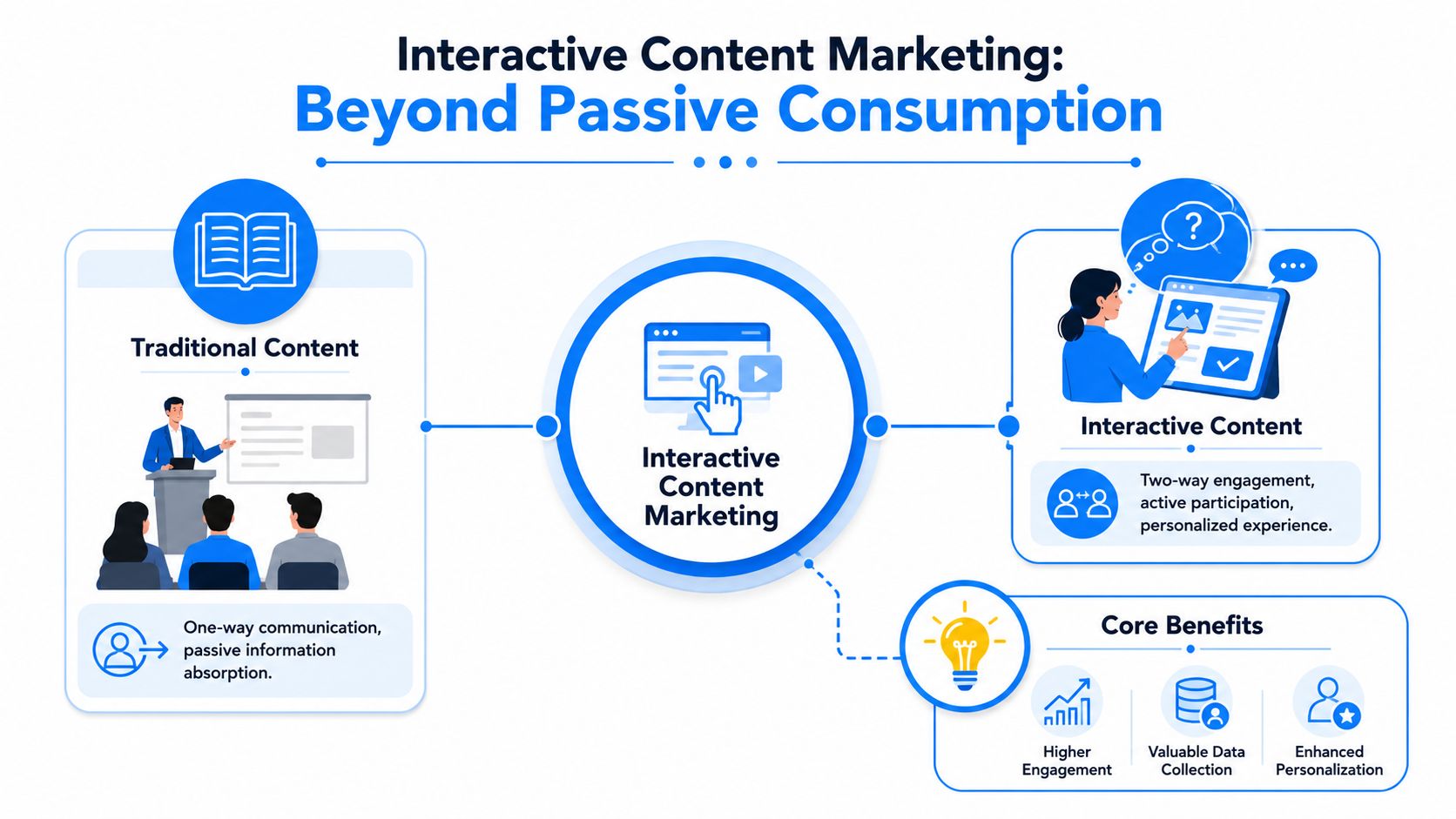
Interactive content marketing is content that requires user input to deliver value. The simplest way to think about it is this: passive content talks at people, while interactive content responds to them.
A product guide is passive. A product finder that asks three questions and recommends a SKU is interactive. A discount popup is passive. A scratch card that reveals an offer after participation is interactive. The format matters less than the exchange.
The value exchange behind it
The shopper gives attention, intent signals, and sometimes contact information. In return, the brand gives entertainment, utility, personalization, or a relevant result. That's the core mechanic.
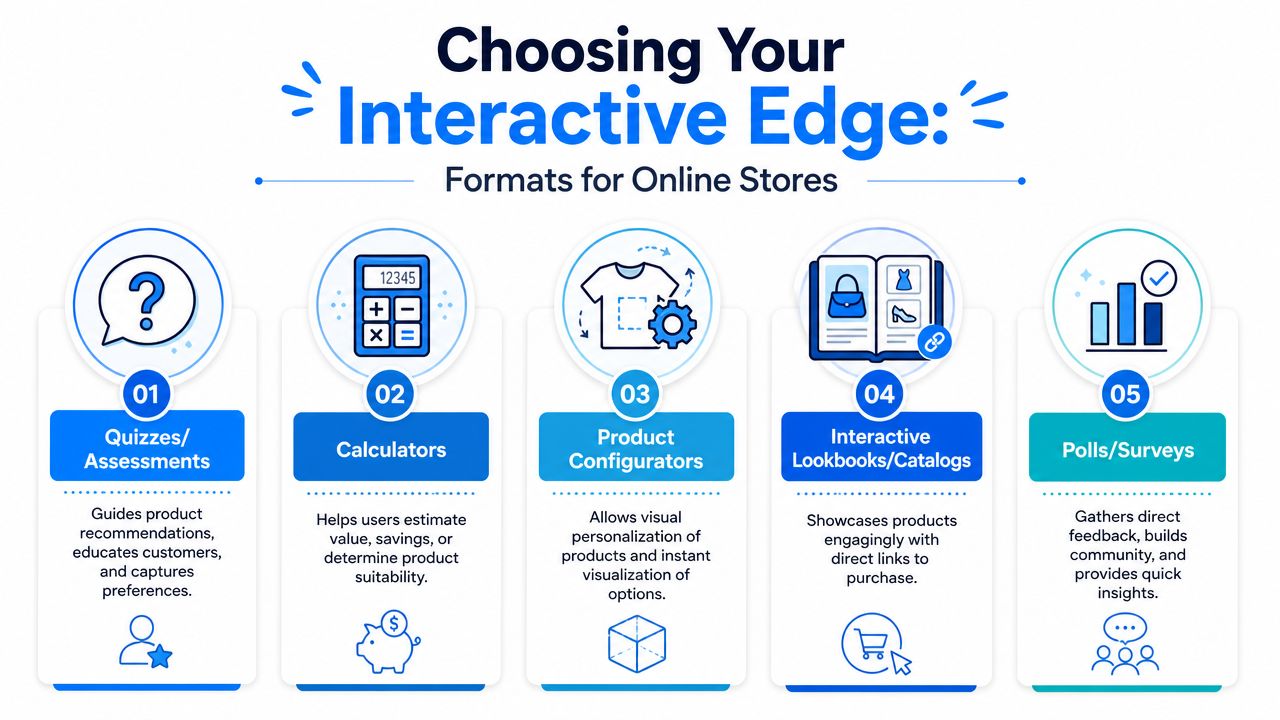
In practice, that can look like:
- A quiz: The visitor answers a few questions and gets a personalized recommendation.
- A calculator: The shopper enters product or usage details and gets a fit, bundle, or savings estimate.
- A game-based lead form: The visitor interacts first, then claims the reward.
- A poll or survey: The customer shares a preference and sees immediate feedback or customized next steps.
The important point is that the output changes because the user participated. That's what separates interactive content marketing from static creative with better design.
Why the format matters less than the job
A lot of teams choose the format before they define the business problem. That's backwards. A quiz, wheel, survey, or configurator is just a shell. What matters is the job it does inside the funnel.
If you need better email capture, build an experience that makes the opt-in feel earned. If you need to reduce return-prone purchases, build something that helps the shopper choose correctly. If you need to segment traffic for Klaviyo flows, ask one or two useful questions and pass those answers downstream.
Practical rule: If the interaction doesn't improve targeting, qualification, or purchase confidence, it probably shouldn't exist.
Interactive content marketing works because it creates a two-way relationship. The visitor isn't just reading your merchandising. They're helping shape it in real time.
Why Interactive Content Drives Ecommerce Growth
Ecommerce teams care about revenue, not applause. That's why interactive content matters. Done well, it reduces hesitation at key moments in the journey and gives marketers better inputs for retention, segmentation, and offer strategy.
Benchmark evidence says interactive formats generate about 2x more conversions and 4-5x more page views, with the strongest lift when they reduce buyer uncertainty around product selection or fit, according to Amra & Elma's interactive content statistics roundup. That last part matters most for stores. The win isn't just that people click more. It's that they decide faster when the experience helps them evaluate options.
It reduces decision friction
A visitor lands on a category page with too many options. That's a merchandising problem disguised as a conversion problem. Interactive tools can narrow the field.
A fit finder, bundle builder, shade matcher, or size helper does more than create engagement. It removes the work the shopper would've had to do alone. That tends to improve the quality of the session because the customer moves from browsing to choosing.
This is especially useful when:
- Products look similar: Supplements, skincare, apparel, and accessories often need guidance.
- The wrong choice feels risky: Shoppers hesitate when returns are annoying or product mismatch is expensive.
- A bundle needs context: Customers buy more confidently when the store explains what goes together and why.
It captures better first-party signals
Interactive content gives you information a static page can't. The visitor tells you what they prefer, what they're solving for, and how close they are to buying. That's useful in the moment, and it's useful after the session.
For ecommerce, that means you can:
- Segment email flows better: A quiz result or product preference can shape welcome, browse, and replenishment content.
- Personalize onsite offers: You can show a more relevant follow-up than a generic discount.
- Qualify list growth: An email attached to declared intent is more useful than an email with no context.
The strongest interactive assets act like merchandising tools first and content assets second.
It makes lead capture feel less extractive
Visitors resist low-value forms because they can see the trade immediately. You want their email. They aren't sure they'll get anything meaningful back. Interactive lead capture changes the feel of that exchange.
A game, assessment, or recommendation flow gives the shopper a reason to participate before the form appears. That doesn't magically solve weak offers. But it does create momentum, and momentum matters in list growth.
For Shopify stores, this is often the missing link between "fun" and revenue. The interaction draws attention. The ultimate reward comes when that interaction feeds a relevant email flow, a usable coupon, or a better product recommendation.
Popular Interactive Formats for Online Stores
The right format depends on the job. Some formats help shoppers choose. Others help you capture leads or learn what customers want. The mistake is treating every interactive asset like a top-of-funnel engagement stunt.
Quizzes and guided recommendation flows
Quizzes work best when shoppers need help getting from "I'm interested" to "this is the right product." They're especially useful in stores with broad catalogs or products that solve different problems for different buyers.
Good quiz use cases include skincare routines, supplement matching, gift finders, and starter bundle selection. The strength of the format is that it turns confusion into a guided path.
What works:
- Short paths: Ask only what changes the recommendation.
- Clear outcomes: Show a product set, not vague advice.
- Follow-up use: Pass answers into your email platform for segmentation.
What doesn't:
- Lifestyle trivia with no merch tie-in
- Too many questions before any payoff
- Generic outcomes that recommend half the catalog
Calculators and product selectors
Calculators are more practical than entertaining. They work when the customer needs to estimate value, fit, quantity, or cost before buying.
A calculator can help a shopper choose package size, compare bundle options, or understand how much product they need. This format tends to work well lower in the funnel because it supports a purchase decision directly.
Use calculators when:
- The product has variable use cases
- The buyer needs reassurance before checkout
- The wrong quantity creates frustration
A calculator fails when the answer feels arbitrary or when users don't trust the inputs. Keep it transparent.
A quick format comparison helps when you're deciding where to start.
| Format | Primary Goal | Best For |
|---|---|---|
| Quiz | Product recommendation | Complex catalogs, segmentation |
| Calculator | Decision support | Quantity, fit, bundle value |
| Gamified popup | Lead capture | Exit-intent, list growth |
| Poll or survey | Insight collection | Merchandising feedback, audience research |
| Interactive lookbook | Product discovery | Visual brands, collections |
For stores comparing list-growth approaches, these lead magnet examples for ecommerce profitability are useful because they show how the offer and format need to match.
A short walkthrough helps show how these formats play out in practice.
Gamified popups for list growth
Gamification matters because it turns passive browsing into active participation and helps brands capture attention and first-party data in a more memorable, two-way exchange, as discussed in Brew Interactive's look at interactive content trends for 2025. For ecommerce, this format is most useful when you have a simple goal: stop anonymous visitors from leaving without giving you a second chance to market to them.
Common game mechanics include spin wheels, scratch cards, pick-a-gift flows, and similar reward reveals. The psychology is simple. Small effort, immediate outcome.
What works:
- Strong timing: Trigger on exit-intent, scroll depth, or second-page view.
- Simple reward logic: One clear benefit after the interaction.
- Coupon control: Unique, one-time codes reduce abuse.
What doesn't:
- Constant interruption
- Games with weak or confusing rewards
- Desktop-first designs that feel clumsy on mobile
Polls, surveys, and interactive merchandising
These formats don't always convert immediately, but they can sharpen merchandising and message strategy. A simple preference poll can help you understand demand. An interactive lookbook can move shoppers from inspiration to click-through without sending them into a category maze.
They work best when you already know what decision the customer is trying to make. They underperform when they're treated like audience entertainment with no path to purchase.
Building Your Interactive Content Strategy
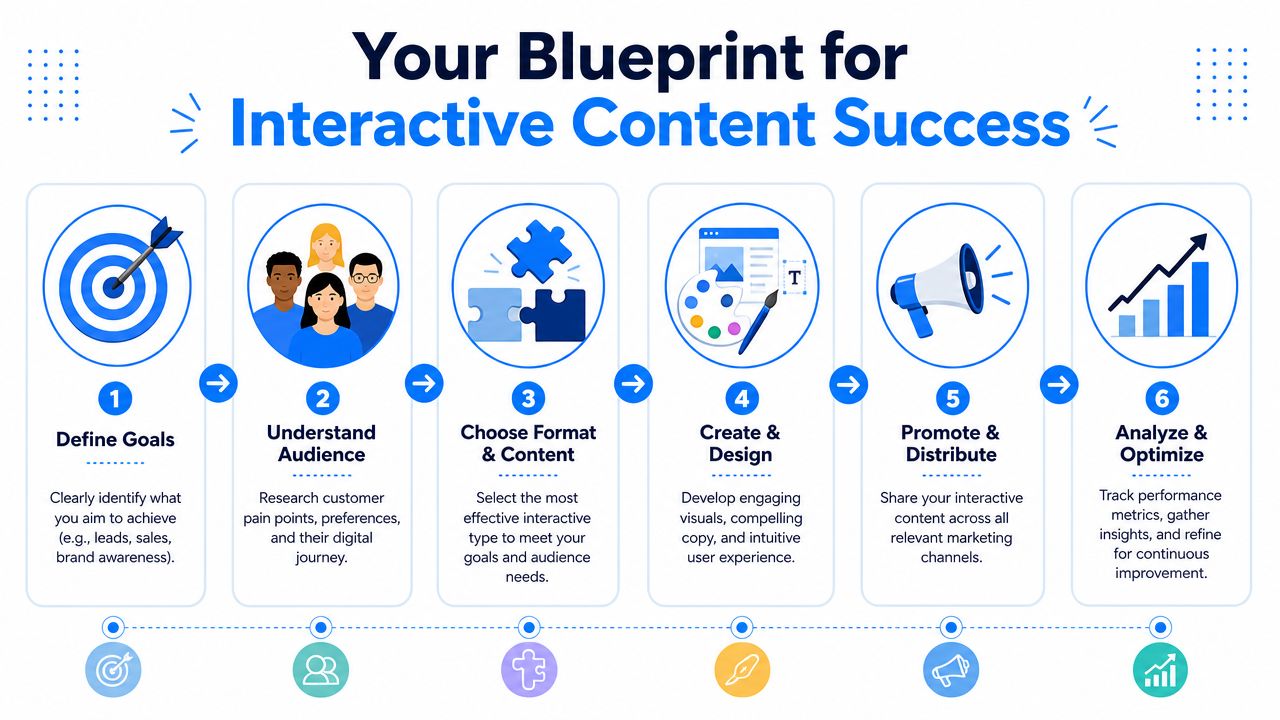
Most interactive campaigns fail before design starts. The store launches a quiz, game, or selector without deciding what business outcome it should move. Then the team looks at plays and completions and still can't answer whether it helped revenue.
Start with the commercial job
Pick one job per asset. Not three.
A good objective sounds like this:
- Capture more email subscribers from abandoning visitors
- Reduce product-selection friction on a high-consideration collection
- Recover more carts with a personalized offer
- Segment first-time visitors for a better welcome flow
A weak objective sounds like "increase engagement." Engagement can matter, but by itself it won't tell you what to build.
Design for one action, not five
Interactive content is most effective when it's treated as a data-collection interface. That means the flow has to be simple, intuitive, mobile-friendly, and tied directly to a conversion objective, with performance measured through engagement, completion, lead generation, shares, conversions, and iterative testing, as outlined in Copy.ai's guide to interactive content marketing examples.
That principle has practical implications for ecommerce teams:
- Minimize steps: Every extra field or click gives visitors a reason to bail.
- Ask only useful questions: If an answer won't change the offer, recommendation, or follow-up, don't ask it.
- Respect mobile behavior: Thumb-friendly layouts beat clever desktop interactions every time.
- Keep the reward obvious: People should know why they're participating.
If a shopper can't understand the interaction in a few seconds, the campaign is too complicated.
Match placement to buyer state
Placement changes performance more than many anticipate. A recommendation quiz belongs near discovery moments. A quantity calculator belongs on a product page. A gamified email capture unit often works better when triggered on exit-intent or after some browsing, because the visitor has enough context to care.
The trigger should match the mental state:
- Homepage or collection pages: Discovery and guidance
- Product pages: Fit, quantity, or bundle clarity
- Cart or exit moments: Offer capture, retention, and recovery
For stores working through trigger strategy, this guide to exit-intent technology for ecommerce popups is a useful reference because it focuses on when to show the interaction, not just what it looks like.
Build the follow-up before launch
The interactive asset is only the front end. The commercial value usually shows up after the submission.
If you capture an email, decide what happens next:
- Deliver the reward immediately
- Send a welcome or recovery sequence
- Use captured preferences for segmentation
- Suppress irrelevant follow-ups
- Track whether the contact buys, not just whether they clicked
Many teams ship the experience and improvise the follow-up later. That's how good interactions become weak campaigns.
Interactive Content in Action Ecommerce Examples
Interactive content earns its keep when it removes a buying obstacle or captures revenue that would otherwise leave the site. In ecommerce, the best examples do one of three jobs well: guide product selection, turn abandoning visitors into leads, or reduce late-stage hesitation before checkout.
A skincare quiz for first-session visitors
Skincare stores often lose first-time shoppers at the discovery stage. The catalog is broad, the products sound similar, and the customer is not ready to evaluate five serums on ingredient lists alone.
A short recommendation quiz gives that shopper a faster path. Ask a few questions about skin type, primary concern, and routine goals. Then return a tight set of recommended products with a clear next step. That works better than dumping a new visitor into a collection page and asking them to sort it out.
The revenue upside is not just the product recommendation. Quiz answers create usable zero-party data. A shopper who selects dryness and sensitivity should not get the same welcome sequence as someone shopping for acne control. That kind of segmentation usually improves email relevance and helps the first purchase happen sooner.
A gamified exit-intent capture flow on Shopify
Gamified lead capture gets dismissed as a novelty tactic. On Shopify stores, it can be a profitable recovery tool when it is tied to exit behavior, coupon control, and a post-capture sales flow.
A common use case is a store with solid traffic but weak email signup rates from a standard discount popup. In that situation, a spin-to-win or scratch-card unit can outperform a static form because the visitor has already signaled intent to leave. The interaction gives the offer a reason to be noticed without interrupting a productive browse session too early.
The setup matters. Show it only to non-subscribers or shoppers who have not purchased. Trigger it on exit intent or after meaningful browsing. Reveal the offer first, then collect the email to claim it. Send a unique single-use code, not a generic sitewide code that spreads to coupon sites and cuts margin.
SmashPops is one example of a Shopify app used for this workflow. It includes gamified popup formats such as Spin the Wheel, Scratch Card, Slot Machine, Pick a Gift, Claw Machine, and Card Dance, plus targeting controls for exit intent, scroll depth, device type, referrer, visit count, and country. The practical value is not the animation. It is the combination of capture, targeting, unique coupon delivery, and integration with email or SMS platforms.
Treat gamified lead capture like an offer system with rules, margins, and follow-up attached.
That is where many stores get it wrong. They launch the game, celebrate the opt-in rate, and ignore redemption quality. A 10% discount shown to everyone can grow the list and still hurt contribution margin. A tighter offer, shown later and only to the right segment, often produces fewer signups but better revenue per lead. If you want to validate whether the popup is helping or just harvesting visitors who would have converted anyway, use a proper test plan like this guide on testing whether your ecommerce popup actually works.
A cart-stage interaction that reduces hesitation
Some of the highest-return interactive content looks simple. A cart-stage tool that answers one purchase-blocking question can recover more revenue than a flashy campaign higher in the funnel.
For apparel, that might be a size finder linked near the cart. For supplements, it could be a usage calculator that confirms how long one bottle lasts. For home goods, it may be a bundle checker that helps the customer confirm they have all required parts before they buy.
These interactions work because they address a specific doubt at the point where the order is at risk. The shopper already wants the product. They need clarity.
Strong ecommerce examples all share the same discipline. The interaction is tied to a commercial outcome such as list growth, first-purchase conversion, or cart recovery, and the experience is built around that job. Fun helps. Revenue is the standard.
Measuring the ROI of Your Interactive Content
Interactive content creates a measurement trap. Teams can see plays, clicks, and completion rates, so they assume success is obvious. It usually isn't. The hard question is whether the interaction created incremental revenue or only got credit for people who would've converted anyway.
A key challenge in interactive content is proving incremental revenue, not just engagement. Marketers need holdout tests and stronger attribution to connect interactive experiences to downstream conversion and repeat purchase, as outlined in Visme's interactive content marketing analysis.
Track the right metrics first
Start with metrics that tie the asset to commercial outcomes:
- Submission rate: How many exposed visitors completed the interaction or opted in
- Coupon redemption quality: Whether claimed offers led to actual orders
- Attributed sales: Revenue linked to the captured lead or issued code
- Post-capture conversion: Whether the subscriber bought later through email or SMS
- Segment value: Which answers, outcomes, or rewards produce better downstream performance
If you're testing a popup or game mechanic, this guide on how to test if a popup works on your website is a solid starting point for setting up cleaner evaluation.
Use holdouts to prove incrementality
The cleanest method is a holdout. Show the interactive experience to one audience segment and suppress it for another comparable segment. Then compare downstream outcomes such as email capture quality, coupon use, and completed orders.
You should also segment by device and buyer intent. An exit-intent game might work very differently on mobile than desktop. A product quiz may help first-time visitors more than returning customers. If you don't separate those groups, you'll end up with an average that hides the true answer.
Good reporting doesn't ask whether people interacted. It asks whether the interaction changed what they bought, when they bought, or whether they bought at all.
If you're running a Shopify store and want a practical way to turn passive popups into interactive lead capture, SmashPops is built for that workflow. You can launch gamified popups, control targeting, generate unique coupon codes, and track the outcomes that matter for list growth and direct sales.
