You're probably already doing “multi-channel marketing” on paper.
Your Shopify store runs Meta ads. You send email campaigns when there's a launch or a sale. Instagram gets posted to when someone on the team remembers. Maybe Google Ads are on in the background. Maybe SMS exists, but only for cart recovery. None of that sounds broken. It just doesn't feel connected.
This is the problem. Most stores don't lose momentum because they picked the wrong channel. They lose it because every channel acts like a separate campaign with separate logic, separate timing, and separate data. A visitor clicks a paid social ad, lands on the site, ignores a generic popup, leaves, sees a retargeting ad later, then gets an email that doesn't match the offer they saw first. The customer journey feels stitched together.
A working multi-channel system feels different. Each touchpoint hands context to the next one. The website captures intent. Email nurtures it. Paid social reinforces it. Search closes demand when the customer is ready. On Shopify, that kind of coordination matters because your store is often the first place channel data becomes usable.
Table of Contents
- From Scattered Efforts to a Unified Strategy
- What Is Multi-Channel Marketing Really
- The Rewards and Realities of Going Multi-Channel
- Your Ecommerce Channel and Tactics Toolkit
- How to Strategize Your Channel Orchestration
- Putting It All Together on Shopify
- Common Pitfalls and How to Avoid Them
- Start Building Your Connected Customer Experience
From Scattered Efforts to a Unified Strategy
A familiar Shopify pattern looks like this. Paid social brings traffic. Email drives some repeat orders. Organic social helps with brand visibility. Search captures branded demand. Each channel can point to a few wins, yet total growth still feels uneven.
That's because disconnected channels create friction you can't see in a single dashboard. The ad team optimizes clicks. The email team optimizes opens. The onsite popup collects addresses, but not necessarily useful ones. Nobody owns the handoff between them.
Brands that coordinate three or more channels see a 287% higher purchase rate than single-channel approaches, according to Improvado's multi-channel marketing strategy analysis. The key word is coordinated. More channels alone don't fix anything. Better orchestration does.
What scattered execution looks like
A lot of stores are living with some version of this:
- Paid traffic without a capture plan sends visitors to product or collection pages, then hopes they convert on the spot.
- Email without context treats every new signup the same, no matter what offer or product category brought them in.
- Retargeting without message continuity shows a discount ad after the customer already saw a different promise onsite.
- Onsite forms with low intent collect weak data, fake emails, or subscribers who never engage again.
Practical rule: If each channel can only explain its own performance, you don't have a multi-channel strategy. You have channel activity.
The shift starts when you stop asking, “Which channel should we add next?” and start asking, “How does one channel make the next one smarter?”
That's also where measurement gets more honest. If you're trying to understand channel contribution beyond platform-native reporting, a good media mix modeling guide helps frame how channels influence each other instead of fighting for last-click credit. And if your long-term goal is a more connected customer journey, this view of omnichannel customer experience is a useful next step.
What Is Multi-Channel Marketing Really
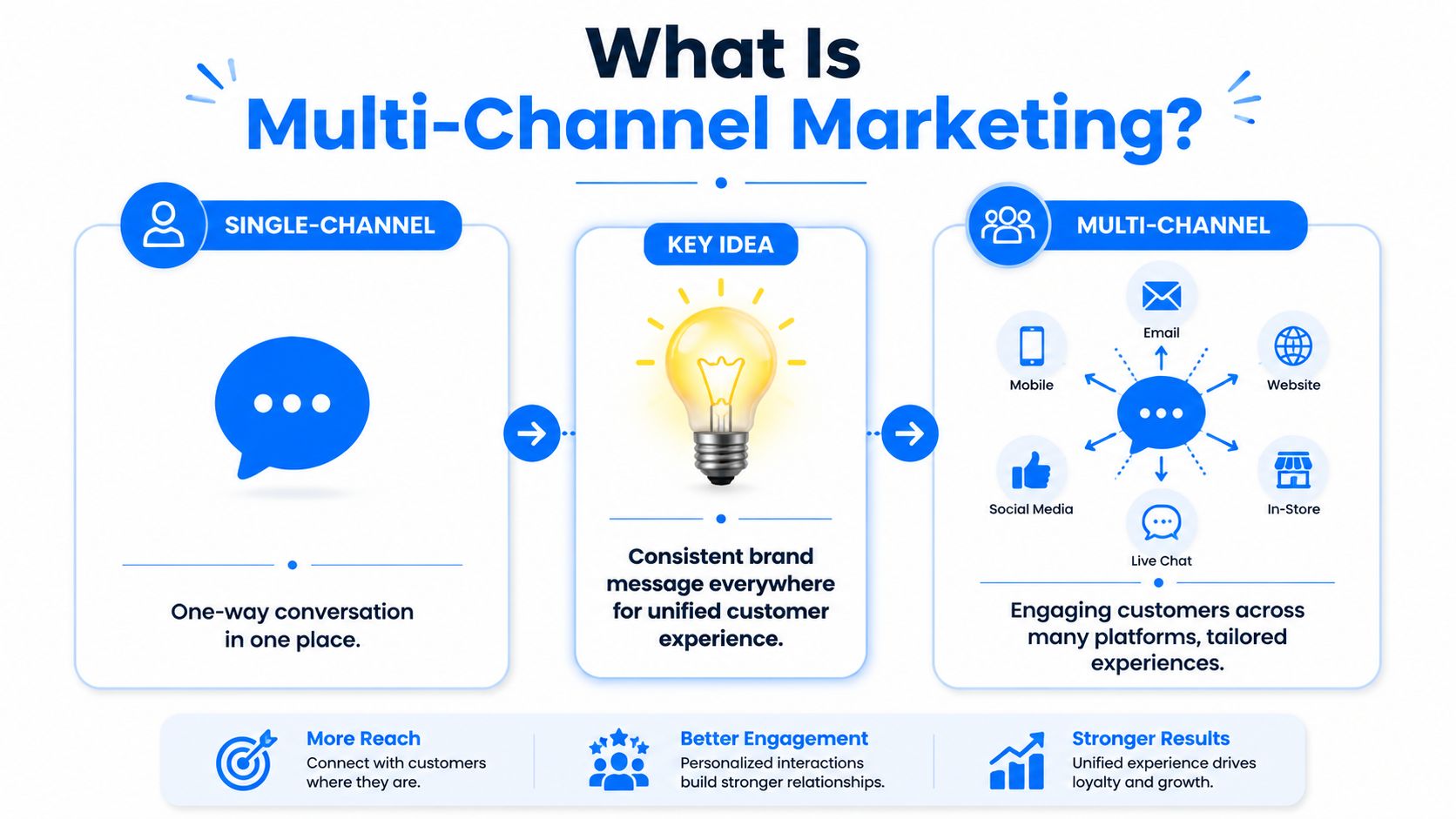
Multi-channel marketing is the practice of reaching customers through multiple touchpoints such as email, paid social, search, SMS, and your storefront. The simple version is presence across channels. The useful version is coordinated presence, where each channel supports a single commercial objective.
A good way to think about it is conversation flow. Single-channel marketing is one conversation in one room. Multi-channel marketing means continuing that conversation wherever the customer happens to be, with the message adapted to the environment.
Single-channel, multi-channel, and omnichannel are not the same
These terms get blurred together, and that creates bad planning.
| Approach | How it works | What it feels like to the customer |
|---|---|---|
| Single-channel | One main marketing path does most of the work | Limited exposure and limited follow-up |
| Multi-channel | Several channels run at once, often with some coordination | More chances to engage and convert |
| Omnichannel | Channels share context tightly and feel seamless | One continuous brand experience |
For a Shopify merchant, multi-channel is often the practical middle ground. You may not have a fully unified system across every touchpoint, but you can still build coordinated flows between store visits, email, paid media, and SMS.
Why this matters now
This isn't a niche operating style anymore. The global multi-channel marketing hubs market was valued at USD 6 billion in 2024 and is projected to reach USD 29.7 billion by 2034, growing at a 17.7% CAGR, according to GM Insights. That projection matters because software demand usually follows operational need. Teams are investing in these systems because channel coordination has become a normal requirement, not an advanced extra.
Here's the practical takeaway for ecommerce teams:
- Your storefront is not just a sales page. It's a channel hub.
- Your data quality shapes every follow-up channel. Bad capture leads to bad email, weak audiences, and noisy retargeting.
- Your message has to adapt without drifting. The ad, popup, email, and landing page don't need identical wording, but they must support the same promise.
If you want a broader beginner-friendly framing, this overview on how to boost your marketing strategy is a helpful companion read.
The point isn't to be everywhere. The point is to make the places you already show up work together.
The Rewards and Realities of Going Multi-Channel
The upside of multi-channel marketing is real, but so is the operational drag when teams treat it casually.
When customers interact with a brand across multiple channels, retention can improve by up to 91%, and multi-channel campaigns average twice the performance of single-channel efforts, based on the verified industry analysis summarized by Improvado. The same body of data notes that 73% of consumers prefer shopping through more than one channel, and omnichannel customers spend 10% more online and 4% more in-store than single-channel shoppers. That combination explains why serious ecommerce brands don't treat channel coordination as a side project.
Where the gains actually show up
The most valuable gains usually appear in four places:
- Customer retention: More touchpoints create more chances to bring buyers back without relying only on paid reacquisition.
- Message reinforcement: A customer who sees the same offer logic across ad, site, and email is easier to move toward purchase.
- Better audience insight: Multi-channel activity gives you a richer picture of what products, offers, and entry points attract attention.
- More stable revenue: When one channel softens, another often carries demand if the system is connected.
What makes it hard
Most merchants underestimate the execution burden.
Brand consistency gets messy fast. The paid media team pushes urgency, the email calendar promotes education, and the site popup asks for a signup with no relation to either. Customers don't think in channels, so they experience that mismatch as confusion.
Attribution also becomes harder the moment a shopper touches multiple devices or enters through one channel and converts through another. The challenge gets worse when the first interaction happens through an interactive onsite element that standard reports don't connect cleanly to downstream revenue.
Multi-channel marketing breaks when teams optimize channels in isolation and then expect the customer to assemble the experience for them.
The trade-offs to accept up front
A practical program usually requires all three:
- More operational discipline than a single-channel setup.
- Shared planning across paid, owned, and onsite experiences.
- Tolerance for imperfect attribution while you improve tracking and handoffs.
The mistake is assuming multi-channel means doing everything at once. It doesn't. It means choosing a handful of relevant channels and making each one improve the next.
Your Ecommerce Channel and Tactics Toolkit
For Shopify stores, the channel mix is usually less mysterious than people make it sound. Most growth programs rely on the same core set. What changes is the role each channel plays and how well the data passes between them.
The core channel roles
Here's a practical comparison for ecommerce teams.
| Channel | Primary Role | Key Metrics |
|---|---|---|
| Nurture, launch, recover carts, drive repeat purchase | Open rate, click rate, conversion rate | |
| Paid social | Prospecting, retargeting, creative testing | Click-through rate, conversion rate, cost efficiency |
| Organic social | Brand familiarity, community, product storytelling | Reach, engagement, traffic quality |
| Paid search | Capture active intent | Conversion rate, cost efficiency, search query quality |
| Onsite engagement | Capture leads, segment visitors, present offers | Signup rate, coupon use, downstream engagement |
| SMS | Urgent reminders and high-intent retention flows | Click rate, conversion rate, unsubscribe behavior |
| Affiliate and influencer | Borrow trust and reach niche audiences | Traffic quality, assisted conversions, code usage |
Most stores already use several of these. The missed opportunity is usually the onsite channel. It gets treated like a form layer instead of a strategic entry point.
The first touchpoint shapes the rest of the funnel
This is the overlooked part of multi-channel marketing. The format of the first interaction changes the quality of the data every later channel receives.
The verified data for this article states that interaction depth at the first channel touchpoint dictates the quality of data passed into the funnel. It also notes that active engagement through gamification correlates with 3x higher purchase intent than passive forms and can lead to 20-30% higher open rates in later email campaigns. That's not a minor UX detail. It changes the economics of list growth, email performance, and retargeting quality.
A static form often captures low-commitment signups. An interactive entry point does more than collect an address. It creates a micro-commitment, increases attention, and usually makes the offer feel earned instead of generic.
Field note: If your popup only asks for an email and gives nothing memorable back, don't be surprised when the rest of the funnel behaves like low-intent traffic.
Channel choices are easier when the entry point is stronger
Once the first capture moment improves, downstream tactics become more useful:
- Email performs better because the list quality is stronger and the welcome sequence starts with clear offer context.
- Retargeting improves because you can build audiences from known onsite behavior instead of only anonymous ad traffic.
- SMS gets safer because you can reserve it for segments that already showed stronger engagement.
- Paid creative gets sharper because the onsite interaction reveals what incentive or product angle pulled interest.
If you're expanding your acquisition mix, channels like Facebook Marketplace as a new channel for growth can work well, but only if your store captures and routes incoming interest effectively.
For creative production across channels, teams often need faster asset turnaround than a designer can handle alone. Tools like the LunaBloom AI video generator can help turn campaign concepts into channel-specific video assets without forcing every test through a full production cycle.
How to Strategize Your Channel Orchestration
A channel toolkit is only useful when you assign each channel a job in the customer journey. The cleanest way to do that is to map the path from first impression to repeat purchase and decide where each touchpoint earns its place.
Map the journey before you map the tools
Start with customer behavior, not software.
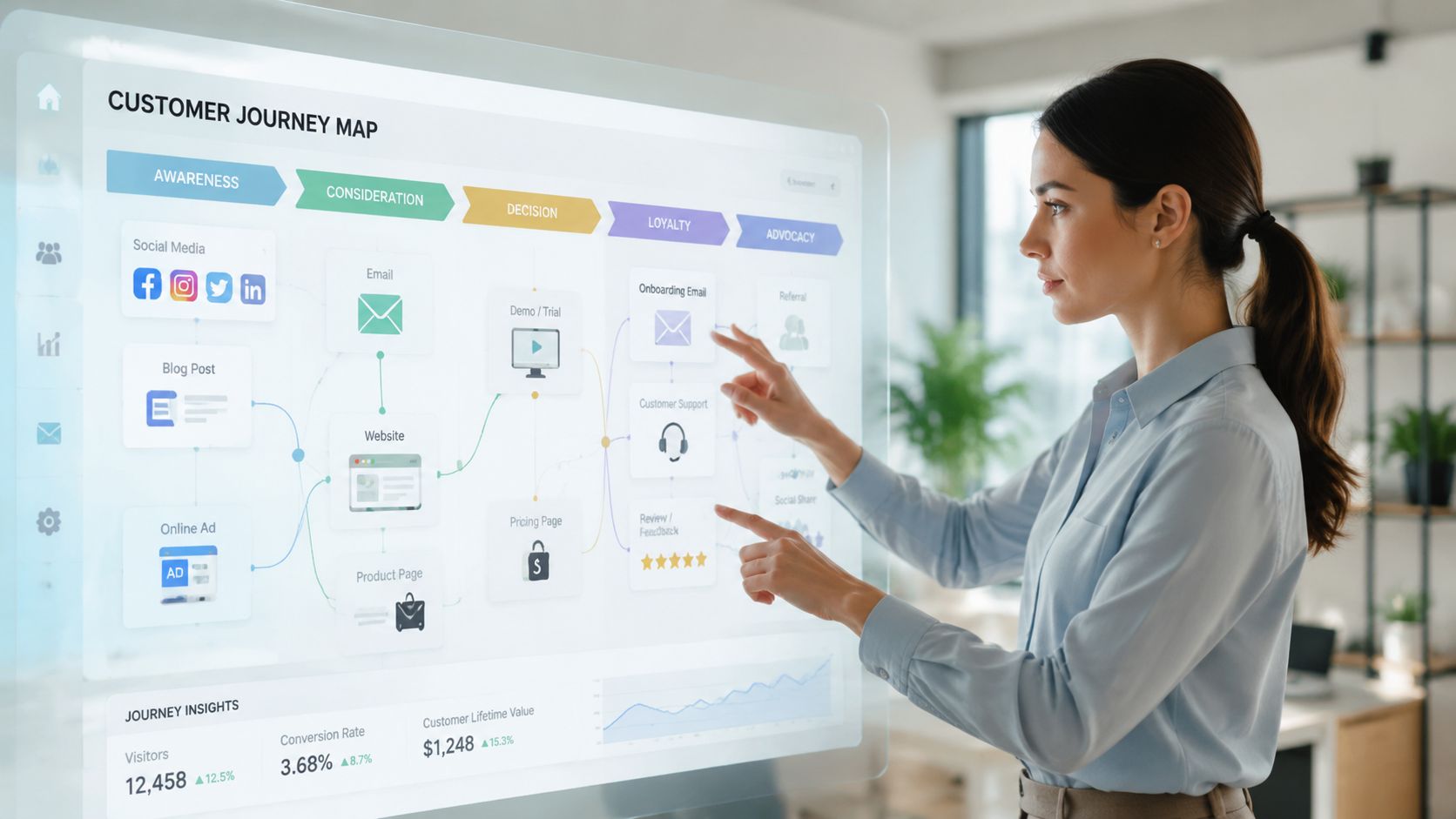
A simple Shopify journey often looks like this:
- Awareness through paid social, creator content, or organic discovery.
- Consideration on product pages, collection pages, and reviews.
- Capture through onsite offers, signups, or account creation.
- Nurture through email flows, retargeting, and sometimes SMS.
- Conversion through checkout reminders, branded search, and offer reinforcement.
- Retention through post-purchase email, replenishment prompts, and new launch messaging.
This exercise surfaces a lot of weak spots quickly. Sometimes awareness is healthy, but capture is weak. Sometimes capture works, but nurture is generic. Sometimes the store converts well on desktop and leaks on mobile.
Assign channels by job, not by habit
A lot of waste comes from using channels because they're familiar.
Use this lens instead:
- Paid social is strong when you need reach and fast creative feedback.
- Search is better for demand capture than demand creation.
- Email works best when it continues a clear story started elsewhere.
- SMS is strongest when timing matters and the customer already trusts the brand.
- Onsite experiences should qualify and route attention, not just interrupt browsing.
That means the handoff matters as much as the channel itself. If a customer arrives from a skincare ad about a hydration bundle, the onsite offer, welcome email, and retargeting message should all respect that context.
Don't build a calendar first. Build a sequence first.
Choose fewer channels and connect them properly
Most Shopify brands don't need every channel. They need a small set to cover the full buying path cleanly.
A practical starting system often includes:
- One acquisition channel such as paid social
- One capture layer on the storefront
- One owned retention channel such as email
- One follow-up layer such as retargeting or SMS
That's enough to build a real multi-channel marketing engine if the experience is coherent.
Putting It All Together on Shopify
Execution on Shopify gets easier when you stop treating the store as a destination and start treating it as the center of the system.
The store is where ad traffic lands, where intent gets observed, and where owned-channel growth usually begins. That makes the first onsite interaction more important than many organizations fully grasp.
Start with the onsite capture moment
If your popup strategy is still a static “join our newsletter” box, that's usually the first fix.
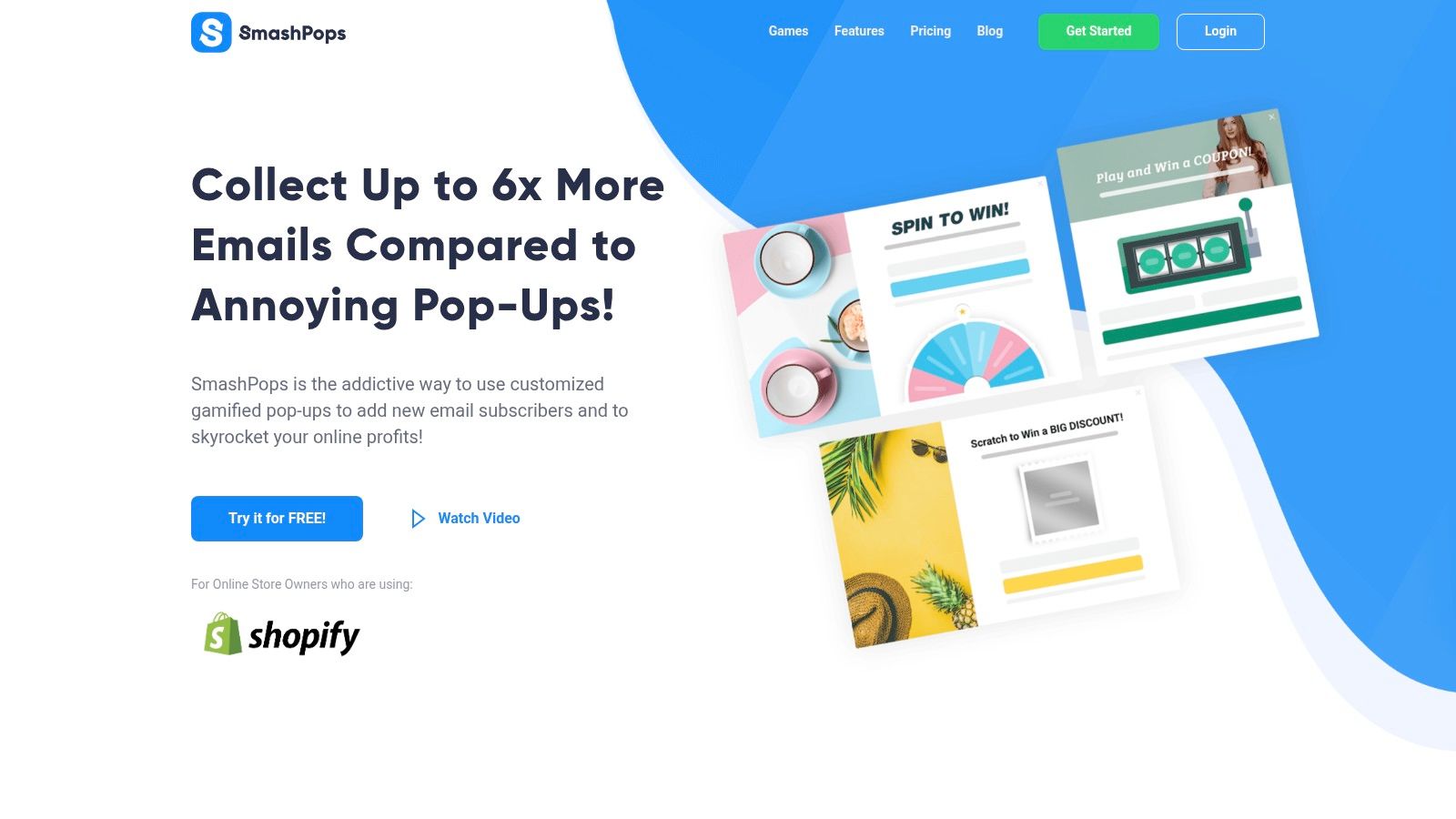
A Shopify store can use an interactive signup experience to turn passive traffic into identifiable visitors with clearer incentive context. One example is SmashPops, a gamified popup tool for Shopify that offers formats like spin wheels, scratch cards, and other game-based capture flows, with integrations for tools such as Klaviyo. In a multi-channel setup, the value isn't only list growth. It's the quality of what enters the rest of your system.
A better entry experience usually does three things at once:
- Captures first-party data you can use immediately
- Frames the incentive clearly so the welcome sequence has context
- Creates a memorable first interaction that supports later email and retargeting performance
Connect capture to follow-up channels
Once the visitor is captured, the handoff matters more than the popup itself.
For example, the email address can move into Klaviyo, where a welcome flow starts with the exact offer or category that triggered the signup. If the visitor doesn't buy, that same behavior can inform retargeting audiences. If they do buy, post-purchase messaging can shift from conversion to retention. If SMS is part of the program, it should sit later in the sequence, not as the first follow-up for everyone.
If you're wiring this inside the Shopify ecosystem, this guide to Shopify Klaviyo integration is useful because it focuses on how store behavior becomes usable retention data.
The process is straightforward in principle:
- Capture the lead onsite with a relevant offer.
- Pass data into your email platform with source context where possible.
- Trigger welcome content that matches the first touchpoint.
- Build retargeting audiences from non-buyers and engaged visitors.
- Suppress recent purchasers from acquisition-focused messages.
- Feed purchase behavior back into future segmentation.
Here's a practical walkthrough format for teams that want to visualize the flow before building it:
Optimize the system instead of guessing
Once the pieces are connected, optimization becomes a control problem rather than a creative guessing game.
According to Twilio's multichannel marketing best practices, optimization works through first-party data segmentation, channel-level personalization, A/B testing, and automation that can reallocate budget toward higher-performing channels in near real time. On Shopify, that means you don't just test email subject lines. You test entry offers, popup formats, audience segments, creative hooks, landing experiences, and retargeting logic as one connected system.
A practical review rhythm looks like this:
- Check capture quality: Are signups engaging later, or just inflating the list?
- Check welcome alignment: Does the first email continue the onsite promise?
- Check audience handoffs: Are retargeting and suppression rules clean?
- Check mobile behavior: Does the capture experience work well on smaller screens?
- Check offer fatigue: Are customers seeing too many disconnected incentives?
The stores that improve fastest usually don't add more channels first. They tighten the handoffs between the channels they already have.
Common Pitfalls and How to Avoid Them
The most expensive multi-channel mistakes usually don't look dramatic. They look normal. An ad account is running. Emails are going out. The store is collecting leads. Revenue still comes in. But the system leaks efficiency everywhere.
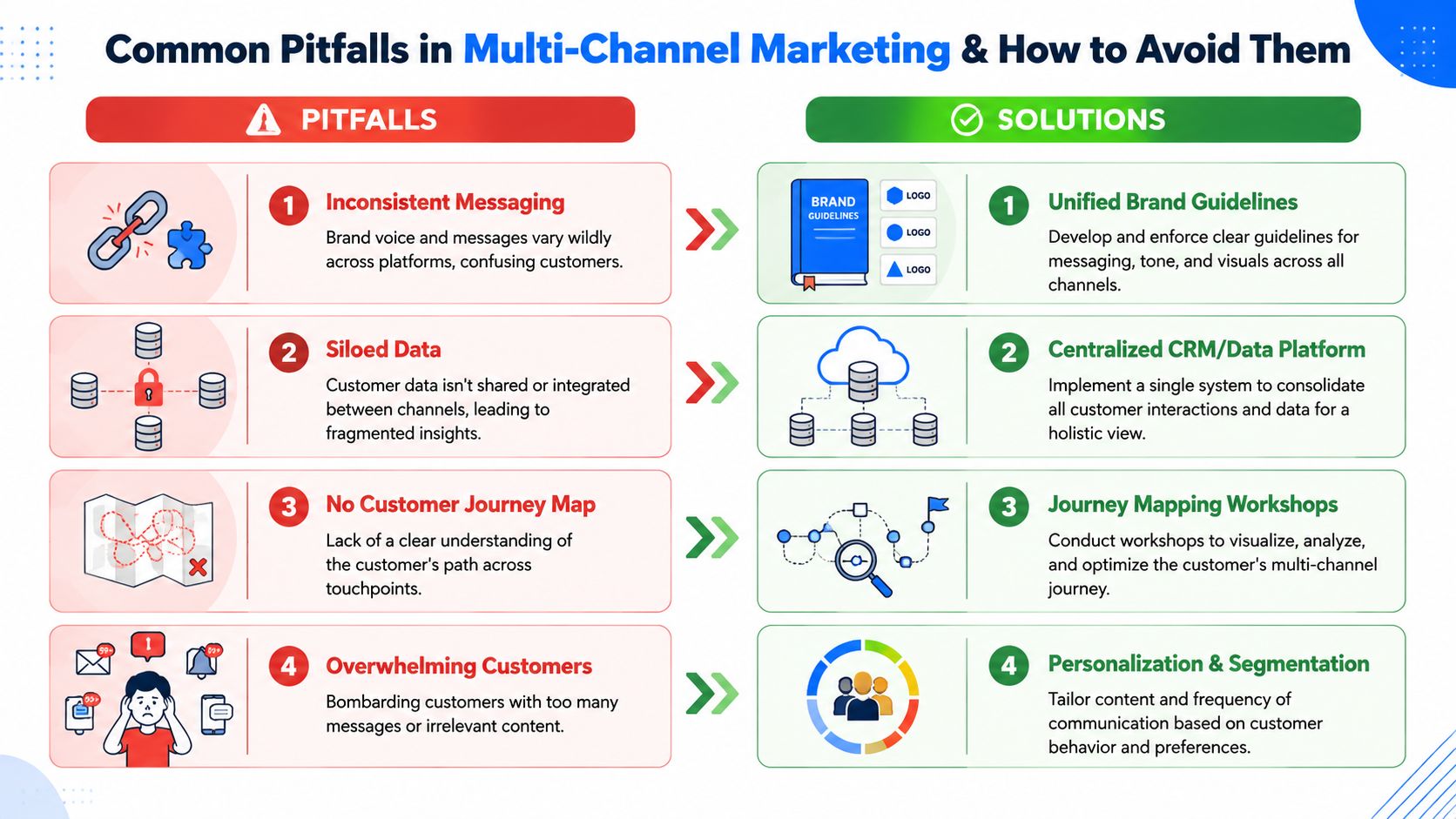
Four problems that show up constantly
- Inconsistent messaging: The offer in the ad, the popup, and the email sequence don't line up.
- Siloed data: Paid, email, and onsite behavior sit in separate tools with weak handoffs.
- No journey ownership: Everyone manages a channel, but nobody manages the sequence.
- Over-messaging: Customers get too many touches because suppression rules are loose or absent.
The last pitfall deserves more attention on Shopify stores using interactive mobile experiences. Verified data indicates that 70% of ecommerce traffic is mobile, and attribution accuracy for game-based mobile interactions can drop by up to 40% when the conversion later happens on another device. That's a serious blind spot for any brand using mobile-first interactive capture and then evaluating performance only through simplified platform reports.
How to reduce the damage
You won't eliminate attribution gaps completely, but you can reduce confusion:
- Use consistent UTM rules so campaign traffic enters analytics with cleaner labels.
- Standardize offer naming across ads, popups, emails, and SMS.
- Review cross-device journeys with skepticism, especially when mobile engagement is strong and desktop conversion is common.
- Centralize customer context inside the tools you already use most, often Shopify plus Klaviyo for many merchants.
Attribution is often least accurate at the exact moment your funnel becomes more sophisticated.
That's not a reason to avoid interactive or mobile-first tactics. It's a reason to measure them more carefully and avoid cutting good entry-point assets just because last-click reports don't tell the full story.
Start Building Your Connected Customer Experience
The practical version of multi-channel marketing is simpler than it sounds. You don't need to be on every platform. You need the channels you already use to stop behaving like strangers.
For most Shopify stores, the fix starts at the first touchpoint. The entry experience on your site determines what kind of lead enters email, what kind of audience enters retargeting, and how much context later channels can use. If that first interaction is weak, the rest of the system has to work harder than it should.
A useful next move is to audit your current flow in one sitting. Look at the first ad or traffic source, the landing page, the onsite capture experience, the welcome email, and the first retargeting touch. Ask one question at each step: does this feel like the same journey, or five separate campaigns?
If you find the biggest gap, don't overhaul everything. Fix the handoff that matters most. For many stores, that's the welcome and exit-intent experience on the site. Get that part right, and the rest of the channel system gets easier to improve.
If your Shopify store is already driving traffic but the handoff into email and follow-up channels feels weak, SmashPops is worth a look. It turns standard popups into interactive signup experiences that fit naturally into a multi-channel system, especially when you want stronger first-party data and a more engaging first touch on the storefront.
