You're probably staring at two tabs right now.
One says GoDaddy. The pitch is simple: get online fast, keep costs down, don't overcomplicate it. The other says Shopify. The pitch is different: build the store properly now so you don't have to rebuild it later.
That's the core GoDaddy vs Shopify decision. It isn't just about templates, checkout buttons, or which dashboard looks cleaner. It's a choice between a general website builder with ecommerce layered on top and a platform built for ecommerce from the start. Those differences show up later in places most merchants don't think about on day one, like campaign tracking, app workflows, international selling, and how painful a migration becomes once revenue depends on the store working smoothly.
I've seen small businesses make both choices for good reasons. A local brand with a short catalog and low maintenance needs can do fine on a simpler stack. A product business with serious growth plans usually regrets choosing simplicity if that simplicity caps what the store can do six months later. That's why this comparison needs to go beyond monthly price and into operational cost.
If you're also thinking about the systems behind your storefront, especially catalog structure and product information quality, this guide to e-commerce solutions for product data management is worth reading alongside your platform decision.
Table of Contents
- Choosing Your Ecommerce Foundation
- GoDaddy vs Shopify At a Glance
- Ecommerce Engine and Core Sales Features
- SEO Marketing and Conversion Tools
- Ease of Use Performance and Support
- Pricing and The Hidden Cost of Scaling
- Final Verdict Which Platform Fits Your Business
Choosing Your Ecommerce Foundation
A florist, a niche apparel brand, and a local coffee roaster can all ask the same question. Should we use GoDaddy or Shopify? The right answer won't be the same for each of them.
The florist often needs a clean site, basic product pages, easy edits, and very little technical overhead. The apparel brand usually needs more. Product organization, conversion tools, channel integrations, better merchandising, and room to change the storefront as the brand grows. The coffee roaster sits somewhere in the middle and that's where this choice gets tricky.
What matters most is the role your store plays in the business. If the site supports the business, GoDaddy can make sense. If the store is the business, Shopify usually makes more sense because the platform itself is centered on selling.
Choose your platform based on the business you want to operate, not the store you can launch in a weekend.
GoDaddy and Shopify come from different origins. GoDaddy started as a domain registrar and later added website-building and commerce tools, while Shopify began as a dedicated ecommerce platform. That history still shapes the products today, including their pricing. One comparison lists Shopify Basic at $29 per month and GoDaddy ecommerce at $20.99 per month, while another shows Shopify starting at $39 per month and GoDaddy at $9.99 per month depending on billing structure and plan family in Larry Ludwig's comparison.
That difference sounds straightforward until you look at what happens when your store needs more than a homepage, a product grid, and basic checkout. Then the platform decision stops being a setup question and becomes an operations question.
GoDaddy vs Shopify At a Glance
The fastest way to understand GoDaddy vs Shopify is this: GoDaddy optimizes for simplicity, while Shopify optimizes for commerce depth.
If you want a quick launch, minimal setup stress, and a website that happens to sell products, GoDaddy fits the brief. If you want a system that's meant to support growing product sales, more channels, and more workflow complexity, Shopify is the stronger fit.
| Criteria | GoDaddy | Shopify |
|---|---|---|
| Best for | Small businesses, simple stores, all-in-one sites | Dedicated ecommerce brands and growth-focused merchants |
| Platform origin | Domain registrar that added site and commerce tools | Ecommerce platform from the start |
| Starting price | Lower entry points, including $9.99 to $20.99/mo depending on plan structure | Higher entry points, including $29 to $39/mo depending on plan structure |
| Ease of use | Easier to get running fast | More setup depth and more moving parts |
| Commerce depth | Basic selling essentials | Deeper reporting, integrations, and scaling tools |
| Customization | More limited | Stronger store customization and app ecosystem |
| Scaling fit | Better for staying small and simple | Better for merchants expecting growth |
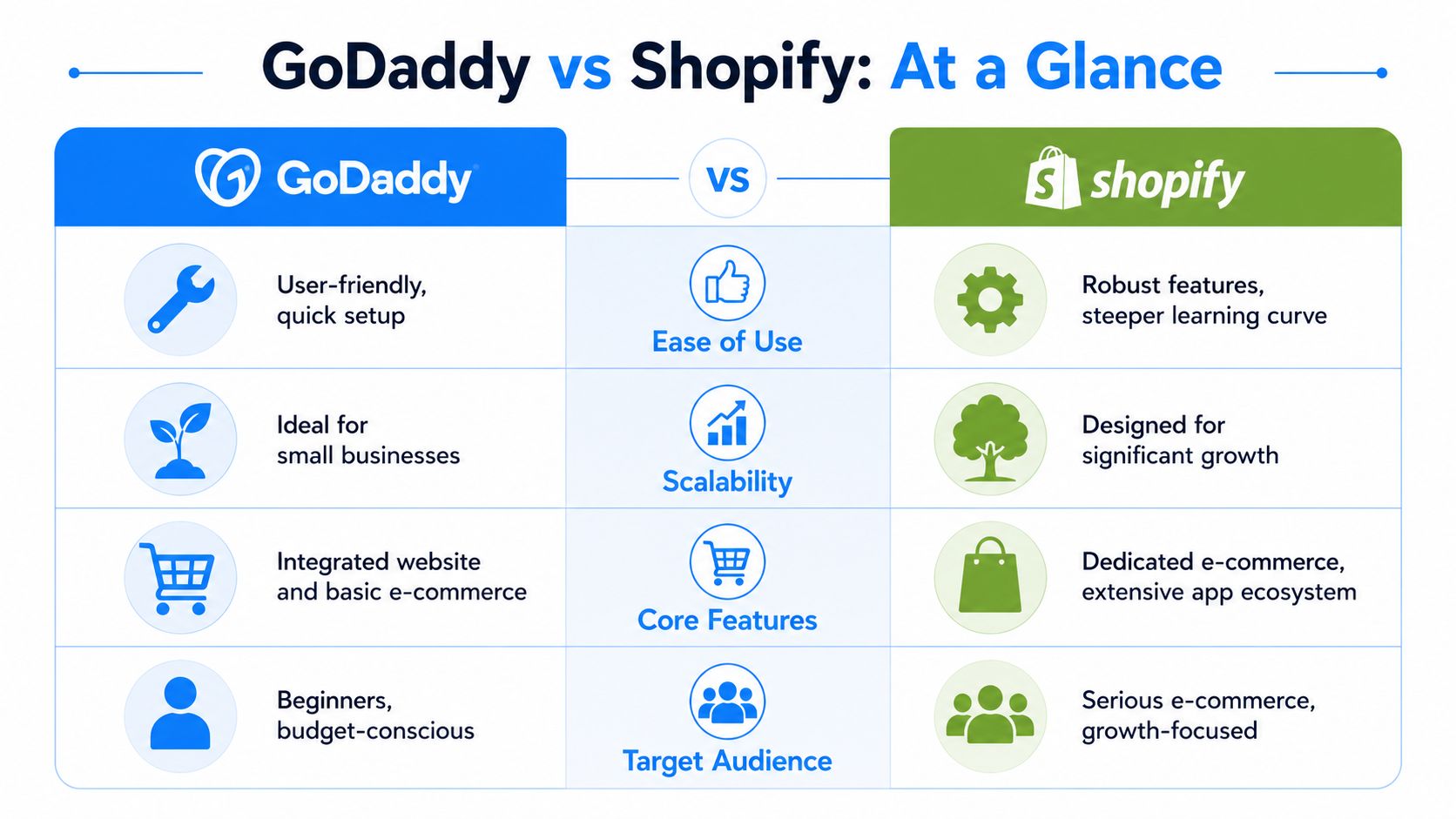
The reason this pattern keeps showing up in comparisons is structural. GoDaddy started as a domain registrar and later added website-building and commerce tools, while Shopify began as a dedicated ecommerce platform. That's why Shopify's plans typically start higher, such as $29 to $39 per month, while GoDaddy offers lower entry points such as $9.99 to $20.99 per month for simpler all-in-one sites, as noted in this platform history and pricing comparison.
Quick decision filter
If any of these sound like you, GoDaddy is probably enough:
- You sell a small catalog: A handful of products, not a large merchandising operation.
- You want low maintenance: Fewer decisions, fewer moving parts, fewer integrations.
- Your website does more than your store: Service business, bookings, local presence, light online selling.
If these sound like you, lean Shopify:
- You're building an ecommerce brand: The storefront is central, not secondary.
- You expect operational complexity: Promotions, apps, analytics, workflows, and channel expansion.
- You don't want to replatform later: You'd rather grow inside one system than outgrow a simpler one.
Shopify usually costs more at the front door. GoDaddy can cost more at the renovation stage.
Ecommerce Engine and Core Sales Features
The biggest practical difference in GoDaddy vs Shopify shows up once you start managing real store operations instead of just setting up pages.
A basic store can look fine on either platform. The gap appears when you need to run promotions, support more sales channels, connect tools, or manage the store like a retail operation instead of a brochure site.
Product setup and day to day catalog work
GoDaddy covers the basics most small merchants need. You can list products, track inventory, and use basic analytics. For a local maker, service add-on store, or business with a simple product line, that's often enough.
Shopify goes further because it was built as a native ecommerce platform. Reviews consistently describe it as stronger for scale, with deeper multichannel selling, broader ecommerce tooling, and a larger app ecosystem, while GoDaddy is positioned more for simple small-business sites and basic online selling in this comparison review.
That difference matters in ordinary tasks:
- Catalog changes: Shopify is better when products, collections, and merchandising need ongoing refinement.
- Operational extensions: If you need apps for bundles, subscriptions, upsells, or workflow support, Shopify gives you more paths.
- Store complexity: GoDaddy stays cleaner because it does less. Shopify asks for more decisions because it supports more scenarios.
A useful rule is to ask whether your products are static or evolving. Static catalogs tolerate simpler tooling. Evolving catalogs usually need more operational depth.
Payments checkout and operational flexibility
Checkout is where “simple” can become limiting.
One analysis notes that Shopify supports multiple payment gateways more robustly, while GoDaddy's commerce setup is simpler. That same comparison highlights a major pricing distinction around transaction structure: third-party payment gateways can trigger additional Shopify platform fees of 2.0% on Basic, 1.0% on Shopify, and 0.6% on Advanced, while GoDaddy's commerce plan is described as having 0% platform-specific transaction fees in Artisan Furniture's comparison.
This isn't a point in favor of one platform in every situation. It's a trade-off.
- GoDaddy advantage: Fewer fee complications if your needs are basic and your payment setup is straightforward.
- Shopify advantage: More flexibility if you need broader gateway support and more advanced checkout operations.
- Real-world implication: The cheaper transaction structure doesn't help much if the platform blocks the workflows you need to grow.
Practical rule: Don't compare payment fees in isolation. Compare them against the revenue operations each platform allows or restricts.
A related example is cart strategy. On Shopify, merchants can layer in post-purchase offers, bundling, list-growth tools, and cross-sell apps more easily because the ecosystem is built for that. If you're planning merchandising tactics like bundles, this guide to frequently bought together strategies is the kind of thinking Shopify supports well.
Later in the buying journey, that flexibility often matters more than the visible monthly plan price.
A useful walkthrough for visual learners is below.
International and multichannel selling
Here, Shopify usually pulls away.
Shopify's competitive advantage for scaling includes omnichannel and point-of-sale workflows, multi-currency international selling, and an app marketplace reported at over 8,000 apps, while GoDaddy is described as lacking native multi-currency support and having fewer extensibility options in this expert review summary.
For merchants, that turns into a simple test:
| Need | GoDaddy | Shopify |
|---|---|---|
| Sell in one primary market | Usually sufficient | Strong |
| Sell across channels | More limited | Better equipped |
| Expand internationally | More constrained | Better prepared |
| Add specialized tools over time | Fewer options | Much broader options |
If your business will stay local or narrowly focused, GoDaddy's limitations may never hurt you. If your store needs to sell across borders, across channels, or across workflows, Shopify is much easier to build on.
SEO Marketing and Conversion Tools
A store doesn't grow because the dashboard is nice. It grows because people find it, trust it, and take action on it.
That puts SEO, content, email capture, and conversion tooling right at the center of the GoDaddy vs Shopify decision. This is also where platform philosophy becomes very visible. Shopify gives merchants more room to build a marketing stack. GoDaddy keeps things simpler, but that simplicity can limit what you can test and connect.
Where stores get found
For search visibility, control matters.
GoDaddy can handle basic SEO tasks for simple websites. That may be enough if your acquisition strategy relies on branded traffic, local demand, or a modest content footprint. But merchants who want more control over structure, landing pages, metadata, content workflows, and integrations usually find Shopify easier to build around over time.
Independent comparisons repeatedly frame Shopify as stronger in areas like SEO tooling, reporting depth, and integrations, while GoDaddy supports the basics. In practice, that means Shopify is better suited to stores that treat content and organic search as a growth channel instead of an afterthought.
A few practical differences matter most:
- Content flexibility: Shopify is generally better for stores that publish ongoing collection pages, campaign pages, and educational content.
- Marketing stack compatibility: Shopify fits more easily into a broader tool ecosystem.
- Iteration speed: Teams can test and refine more without hitting platform walls as early.
Better SEO tools don't guarantee rankings. They do remove avoidable friction when your team is trying to improve the site.
Where traffic turns into leads and sales
Conversion tooling is where the ecosystem gap gets obvious.
On GoDaddy, most merchants stay closer to built-in functionality or lightweight embeds. On Shopify, the app ecosystem makes it easier to add specialized tools for popups, upsells, segmentation, and email capture. That doesn't automatically mean better results. It means more ways to run serious conversion programs.
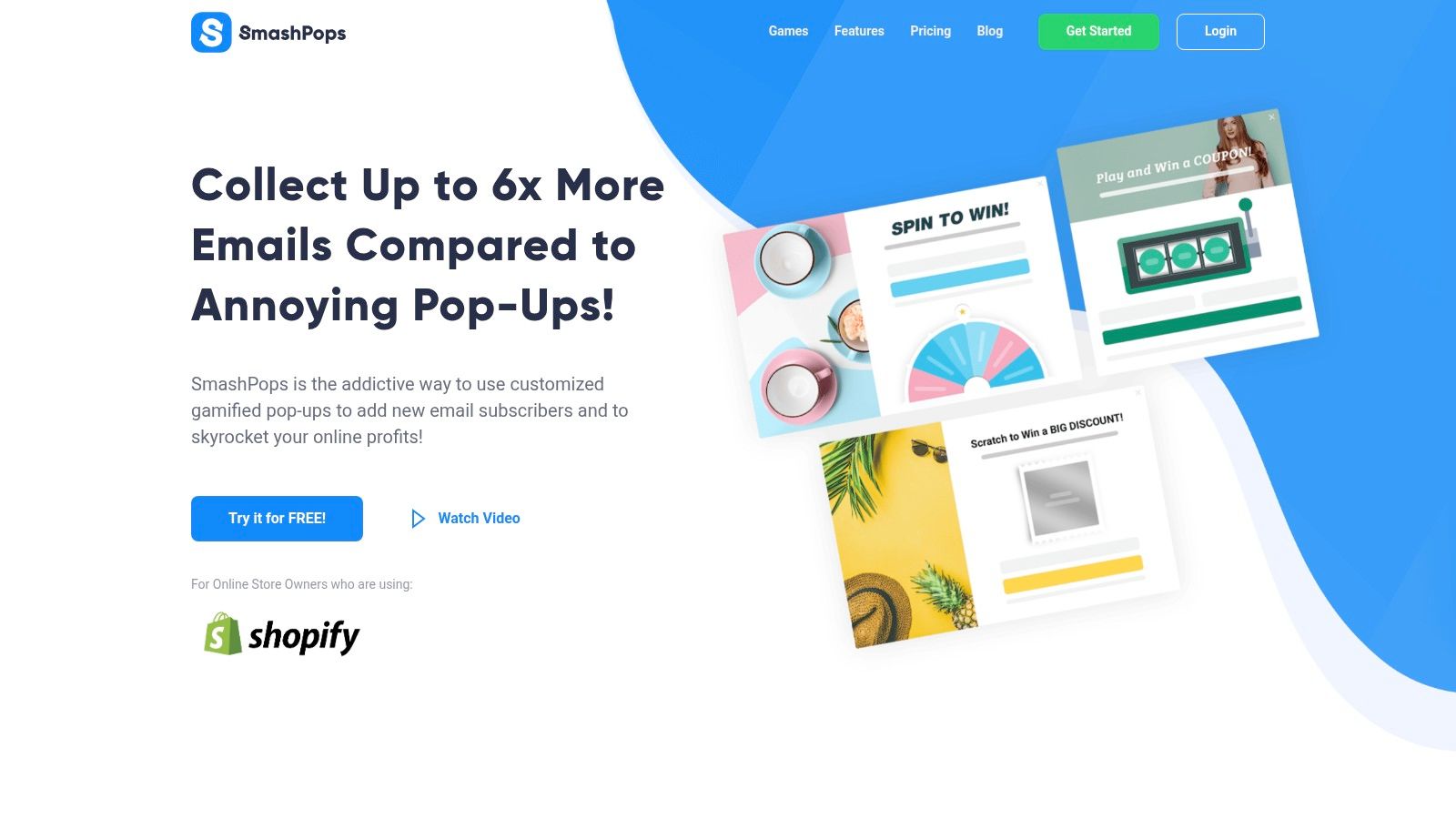
One example is SmashPops, a Shopify app that adds gamified pop-up campaigns for email capture and coupon collection. That type of tool fits naturally into the Shopify ecosystem because merchants often want more than a static signup box. They want better timing, stronger offers, and more engaging capture flows. If you're evaluating when and how these overlays should appear, this breakdown of exit intent technology is a useful tactical reference.
The practical takeaway is straightforward:
- If your marketing is simple, GoDaddy can be enough. You may not need much beyond email basics, product pages, and a clean site.
- If your marketing depends on testing, Shopify gives you more room. Apps, integrations, and specialized tools are part of how many stores operate.
- If list building matters, the difference gets larger. Shopify makes it easier to plug lead capture into the rest of your lifecycle marketing.
That doesn't mean every Shopify store should install a pile of apps. In fact, many stores slow themselves down that way. But having the option to add the right tools when you need them is a major advantage.
Ease of Use Performance and Support
Ease of use is where GoDaddy earns a lot of its appeal. For many beginners, that appeal is legitimate.
The dashboard feels more approachable, the setup path is more guided, and the product asks fewer questions. That's helpful when you're launching your first site and don't want to make twenty architecture decisions before the homepage goes live.

What beginners feel in week one
GoDaddy usually feels easier because the product is doing less. That's not a criticism. For small merchants, less can be useful.
Shopify takes longer to feel comfortable because the platform exposes more of the ecommerce machine. More settings, more channels, more integrations, more store logic. That can feel heavier at the start, but it also means the system is better prepared when the business asks more of it.
Independent reviews consistently frame Shopify as a native ecommerce platform with deeper sales and marketing tools, while GoDaddy is positioned as a simpler website builder with basic commerce features. That architectural difference is a key reason Shopify is considered the stronger choice for businesses that expect to scale, according to WebAppMeister's review.
What operators feel after launch
The early ease-of-use story changes once the store is live.
Operators care about reliability, support quality, and whether the backend helps them solve sales problems quickly. A simple interface matters less when you're managing promotions, customer journeys, and order operations every day.
A few practical observations tend to hold:
- GoDaddy is easier to start: Good for owners who want low-maintenance basics.
- Shopify is easier to grow into: Better for teams that expect to add process, tooling, and channel complexity.
- Support context matters: Ecommerce-focused support is more valuable when the issue affects selling, not just site setup.
The best platform isn't the one that feels easiest on day one. It's the one your team can still operate cleanly once the store becomes important.
Performance sits in the background of all this. Both platforms handle hosting for you, which removes a lot of technical overhead. But from an operational standpoint, Shopify's commerce-first architecture is better aligned with stores that expect heavier selling demands over time.
Pricing and The Hidden Cost of Scaling
Most buyers start this comparison by looking at monthly plan prices. That's understandable and usually incomplete.
GoDaddy often looks cheaper at the beginning. Shopify often looks more expensive. Both impressions are true in the narrow sense and misleading in the broader one. Total cost of ownership depends on what the business needs now, what it will need later, and whether the cheaper option creates a more expensive migration.
Monthly price is only the visible cost
One verified comparison shows Shopify Basic at $29 per month and GoDaddy ecommerce at $20.99 per month, while another shows Shopify starting at $39 per month and GoDaddy at $9.99 per month, depending on plan structure and billing context, as summarized in the earlier platform comparison. That spread explains why merchants can find apparently conflicting price comparisons online.
But subscription price is only one layer. You also need to think about:
- Payment structure: Shopify may charge additional platform fees when you use third-party gateways, as covered earlier.
- App dependency: Shopify's flexibility can come with extra software costs if your store needs specialized functions.
- Operational overhead: A simpler platform can be cheaper because it supports fewer workflows, not because it delivers the same capability at lower cost.
If you're modeling what your store needs to earn rather than just what the plan costs, a Shopify profit margin calculator is a useful planning tool.
The expensive part is switching late
The hidden cost in GoDaddy vs Shopify isn't just feature gap. It's migration friction.
A critical point many comparisons miss is the operational migration cost of outgrowing GoDaddy. Re-platforming to Shopify later can involve rebuilding workflows, themes, and app integrations, which can disrupt conversion tracking, SEO, and campaign continuity, as noted in this migration-focused comparison.
That disruption is where the cheap decision stops being cheap.
Here's what merchants usually underestimate:
- Tracking resets: Marketing teams lose continuity when analytics, attribution, and conversion paths change.
- Design rebuilds: Even if branding stays the same, theme logic and page structure often need to be recreated.
- Workflow replacement: Email tools, promotions, checkout logic, and merchandising setups rarely migrate cleanly as a full system.
A low-cost launch can become a high-cost transition if the original platform can't expand with the business.
This doesn't mean GoDaddy is a mistake. It means GoDaddy is a smart choice only when staying small and simple is a realistic plan, not just a temporary starting point.
Final Verdict Which Platform Fits Your Business
For most dedicated ecommerce businesses, Shopify is the safer long-term bet.
It's built for selling, extending, and scaling. If your store will be central to the business, if you plan to market aggressively, or if you expect to add complexity over time, Shopify gives you more room without forcing a rebuild later.
Choose GoDaddy if this sounds like you:
- You run a small business that needs a site first and a store second.
- You sell a limited catalog and don't expect a lot of operational complexity.
- You care more about speed, simplicity, and minimal maintenance than feature depth.
Choose Shopify if this sounds like you:
- You're building a product brand, not just adding a shop page to a website.
- You want stronger control over selling workflows, marketing tools, and integrations.
- You expect your store to grow in reach, complexity, or importance.
There is one important exception. For very small merchants not yet ready for advanced apps or custom design, GoDaddy's simplicity and lower starting cost might offer better short-term economics. Shopify can feel like overhead if the extra capability goes unused, which is why GoDaddy remains a rational choice for businesses prioritizing minimal maintenance and less decision fatigue, as discussed in this small-merchant comparison.
The cleanest summary is this: GoDaddy is a good starter platform for simple selling. Shopify is a better operating system for ecommerce businesses that plan to grow.
If you're on Shopify and want to turn more traffic into email subscribers and first purchases, SmashPops is one option to evaluate. It adds gamified pop-ups to Shopify stores so you can collect emails, deliver one-time coupon rewards, and run targeting based on triggers like exit intent, scroll depth, device type, and country.
