Most “spin the wheel prize ideas” lists are written for trade shows and office parties: candy, branded pens, a free t-shirt. If you run an online store, you need something different. Your prizes have to be delivered digitally, redeemed at checkout, and cheap enough that every winner is still a profitable customer.
This guide is built for that situation. Below you will find 42 prize ideas for a spin-to-win popup on Shopify or any ecommerce site, grouped by type, plus the part most guides skip: how to set the odds so your wheel feels generous without eating your margin.
Quick answer: what are the best spin the wheel prizes for an online store?
The prizes that work best online are 10–15% off the first order, free shipping, a free sample or gift with purchase, and one rare “jackpot” (for example 25% off or a free product). Make every slice a winner, give the cheap prizes most of the probability, and use unique one-time codes so prizes can’t be shared.
Table of Contents
- What makes a good spin-to-win prize online
- Discount prizes (1–8)
- Shipping prizes (9–12)
- Free products and gifts (13–20)
- VIP and experience prizes (21–27)
- Prizes that grow the order (28–33)
- Seasonal prize ideas (34–39)
- Low-cost brand prizes (40–42)
- How to set the odds on your prize wheel
- The margin math: what a wheel really costs
- Ready-made prize wheels by store type
- Mistakes to avoid
- FAQ
What Makes a Good Spin-to-Win Prize Online?
A prize wheel on a website is not a game of chance in the casino sense. It is a lead capture form with a fun reveal. The visitor enters an email (or phone number), spins, and gets a reward they can use on their first order. That changes what a “good” prize is:
- It can be redeemed at checkout. Ideally it is a Shopify discount code: a percentage, a fixed amount, free shipping or a buy X get Y offer.
- It pushes a first purchase. A prize that only makes sense after three orders does nothing for a new visitor.
- It is worth playing for. If every slice says “5% off,” visitors notice, and the game feels fake.
- It protects your margin. The expensive prizes exist, but they are rare.
- It can’t be shared. One-time unique codes stop your “25% OFF” jackpot from ending up on coupon sites.
If you are new to gamified popups in general, start with our guide to gamified pop-ups, which covers the different game types and conversion benchmarks. This article focuses only on what goes on the wheel.
Discount Prizes (1–8)
Discounts are the backbone of most wheels because they are simple, instantly understood and easy to deliver as a code.
- 10% off the first order. The default “common” prize. Cheap enough to give often, big enough to feel real.
- 15% off the first order. Your “medium” prize. Visitors who land on it feel lucky.
- 20% off orders over a threshold. For example 20% off orders over $75. The minimum protects you and nudges a bigger basket.
- $5 off. Fixed amounts feel more concrete than percentages on low-priced products.
- $10 off orders over $60. A fixed amount with a minimum is one of the safest prizes you can offer on a wheel.
- Tiered discount. “Save $10 on $50, $25 on $100.” The visitor chooses how much to spend, and many spend more.
- Extra 5% off sale items. Useful during clearances, when a regular discount would stack too deep.
- 25% off (the jackpot). One rare slice with a big number makes the whole wheel exciting. Keep its probability very low (1–3%).
Shipping Prizes (9–12)
Shipping costs are one of the most common reasons shoppers abandon a cart, which makes shipping prizes surprisingly powerful for their cost.
- Free standard shipping. Often valued more than a 10% discount, especially on smaller orders.
- Free shipping with no minimum. If you normally have a free shipping threshold, removing it is a strong prize.
- Free express upgrade. Perfect in the weeks before Christmas or Mother’s Day, when delivery speed matters most.
- Free returns or exchanges. Removes risk for first-time buyers in fashion and footwear, where sizing is the main worry.
Free Products and Gifts (13–20)
A free product often costs you less than its perceived value, because you pay cost price while the customer values it at retail price.
- Free sample or travel size. Ideal for beauty, skincare, coffee and food brands. It also introduces a second product.
- Free gift with purchase over $X. A tote bag, a mini candle, a keychain: choose something with a low cost and a high “cute” factor.
- Free accessory. A case with a phone accessory, a cleaning kit with sneakers, a pouch with jewelry.
- Mystery gift. Curiosity is the whole point of a wheel, and a mystery gift doubles down on it. Use it to move slow stock.
- Buy one, get one free (BOGO). Works well for consumables and low-cost items.
- Buy two, get one free. A natural basket builder for socks, snacks, candles or any product people buy in multiples.
- Free gift wrapping. Costs very little and is very relevant in Q4.
- Free full-size product (grand prize). A best-seller as the rare jackpot slice. Make sure someone can actually win it.
VIP and Experience Prizes (21–27)
These prizes cost little or nothing in cash but make the winner feel special, which is great for brands that don’t want to train customers to wait for discounts.
- Early access to the next drop or collection. Very effective for streetwear, sneakers and limited editions.
- VIP list membership. Members-only offers, first look at sales and a special badge in emails.
- Double loyalty points on the first order, if you run a loyalty program.
- $10 store credit for the next order. Brings people back for a second purchase, which is where most stores make their profit.
- Free personalization or engraving. A strong prize for jewelry, gifts and leather goods.
- Free consultation. A styling session, skin consultation or setup call for higher-priced products.
- Entry into a monthly giveaway. Only if you follow the sweepstakes rules in your country (no purchase necessary, published rules). Keep it as a bonus, not the only prize.
Prizes That Grow the Order (28–33)
These prizes are designed to raise your average order value instead of just lowering the price.
- Free product with a bundle. “Win a free cleanser when you buy the 3-step routine.”
- Discount on your best-seller. Sends new visitors straight to the product that converts best.
- Percentage off one collection. A smart way to clear seasonal stock without discounting the whole store.
- Free add-on at checkout. Batteries, a care kit, an extra strap. Small, cheap and useful.
- First month of a subscription at a discount. For subscribe-and-save products, the first box is the hardest to sell.
- Free refill or replacement pack. Great for products with a consumable part.
Seasonal Prize Ideas (34–39)
Changing the prizes (and sometimes the game) with the calendar keeps returning visitors interested.
- Black Friday: an extra 5–10% on top of sale prices, or early access to the sale for wheel players.
- Christmas: a free gift with every order before a set date. Consider switching from a wheel to a “pick a gift” game.
- Valentine’s Day: a free gift for their partner with orders over a set amount.
- Mother’s Day: a free handwritten card and gift wrapping.
- Back to school: a bundle discount on kits and essentials.
- Summer: free shipping week to support slower months.
Low-Cost Brand Prizes (40–42)
- A donation to a cause in their name. A strong fit for sustainable and mission-driven brands.
- Exclusive content. A recipe ebook, a styling guide, a training plan. It costs nothing to deliver and showcases your expertise.
- The “golden ticket”: a free order (capped). One extremely rare slice, for example “your order is free, up to $100.” Even if almost nobody wins it, it makes the wheel memorable.
How to Set the Odds on Your Prize Wheel
Here is the key thing to understand: every slice of the wheel looks the same size, but you decide how often each one wins. In SmashPops and most spin-to-win tools, you assign a probability to each prize. A slice that takes up one-sixth of the wheel can win 40% of the time or 2% of the time.
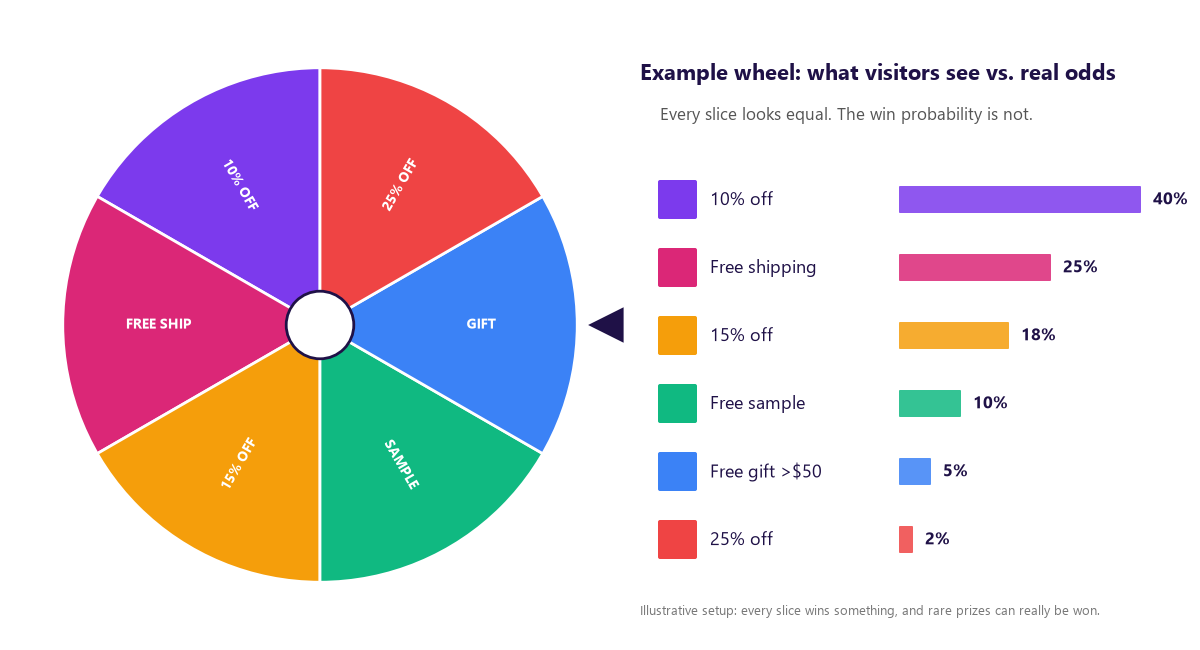
A simple structure that works for most stores:
| Prize tier | Examples | Number of slices | Share of wins |
|---|---|---|---|
| Common | 10% off, free shipping | 2 | 60–70% |
| Medium | 15% off, free sample | 2 | 25–35% |
| Rare (jackpot) | 25% off, free product, free gift over $50 | 1–2 | 2–7% |
Three rules keep this honest and legal:
- Every slice must be winnable. If you advertise a free product, give it a real (small) probability. Showing a prize that can never be won misleads customers and can create legal risk.
- Every spin wins something. “Try again” or “No luck” slices frustrate people after they have just given you their email.
- No purchase required to play. The visitor gives an email, not money. If you add anything that looks like a sweepstakes (a draw, a cash prize), check the rules in the countries you sell to.
The Margin Math: What a Wheel Really Costs
A weighted wheel often costs less than a plain “15% off” popup, even though it advertises bigger prizes. Here is an example for a store with a $60 average order, using the odds above:
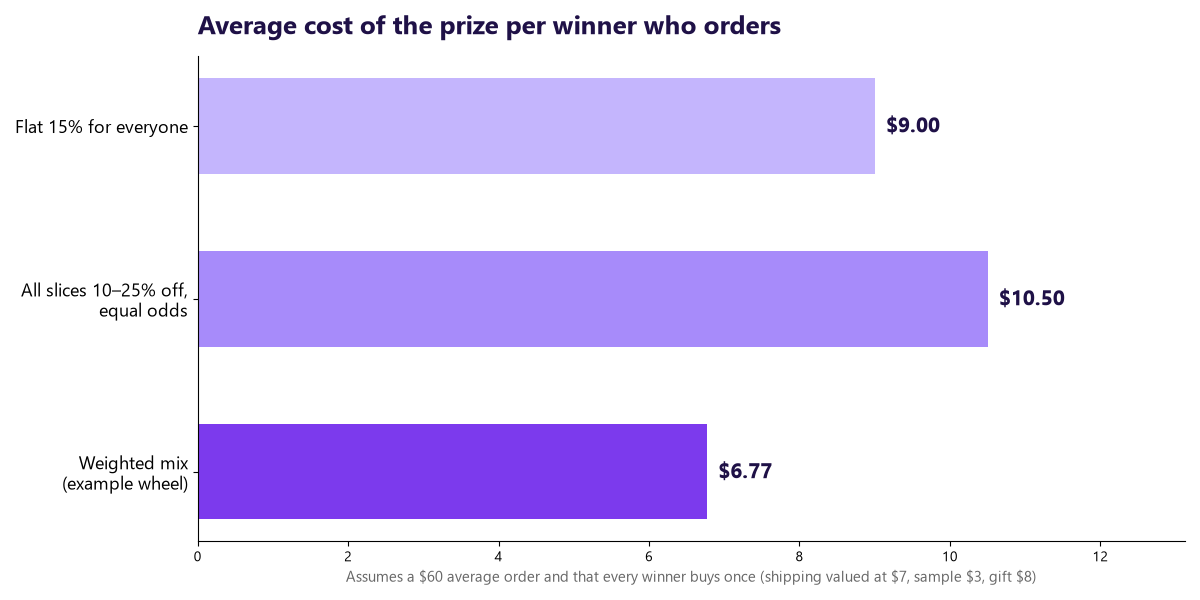
- Flat 15% off for everyone: $9.00 per order.
- A wheel with 10%, 15%, 20% and 25% off at equal odds: $10.50 per order. Bigger numbers, equal odds, higher cost.
- The weighted example wheel (free shipping valued at $7, sample at $3, gift at $8): $6.77 per order, while still showing a 25% jackpot and a free gift.
To run this calculation for your own store, multiply each prize’s cost by its probability and add them up. Then check the result against your gross margin with our Shopify profit margin calculator. The number to watch is not “how much did we give away” but “how much margin is left on a first order that would not have happened without the wheel.”
Ready-Made Prize Wheels by Store Type
Copy one of these as a starting point and adjust the numbers to your margins.
| Store type | Common (most wins) | Medium | Rare jackpot |
|---|---|---|---|
| Fashion & apparel | 10% off, free shipping | 15% off, free returns | Free tote or 25% off |
| Beauty & skincare | Free sample, 10% off | Free mini-size over $40 | Free full-size best-seller |
| Food, coffee & snacks | Free shipping, 10% off | Buy 2 get 1 free | Free bag or box |
| Home & decor (higher AOV) | $10 off over $80, free shipping | $25 off over $150 | Free accessory worth $50 |
| Jewelry & gifts | Free gift wrapping, 10% off | Free engraving | Free matching piece |
| Subscriptions | First box 20% off | Free extra item in first box | First box free |
Mistakes to Avoid
- Using one shared code. “SPIN25” will be on coupon sites within a week. Use automatically generated one-time coupons instead.
- Making all prizes nearly identical. 5%, 6%, 7% and 8% off on one wheel looks like a trick.
- Forgetting an expiry date. A prize valid for 24–72 hours gets used. A prize with no expiry gets forgotten.
- Showing the wheel too early. A wheel shown after some scrolling, on exit intent or on a second visit converts better than one fired at 0 seconds. See our guide to exit-intent technology and the display rules settings.
- Never changing the prizes. Rotate seasonal prizes and test one change at a time.
FAQ
What should I put on a spin the wheel for my online store?
Use 5 to 8 slices: two common prizes (10% off, free shipping), two medium prizes (15% off, a free sample or gift) and one or two rare jackpots (25% off or a free product). Every slice should be a real, winnable prize.
How many slices should a prize wheel have?
Six is a good default. It is easy to read on mobile and leaves room for common, medium and rare prizes. Klaviyo’s native wheel, for example, allows 2 to 6 slices, while dedicated gamified popup apps usually allow more.
Is a spin to win popup legal?
In most places, a free-to-play wheel where everyone wins a discount is treated as a promotion, not gambling, because no purchase is required to play. Problems start when prizes are shown but can never be won, or when you run a cash draw without published rules. If in doubt, check the promotion rules for the countries you sell to.
Should every spin win a prize?
Yes. The visitor has just given you their email. A “no prize” result feels like a bait-and-switch and lowers trust in your brand right before their first purchase.
What is the best spin the wheel prize for getting a first order?
Free shipping and 10–15% off are the most reliable. Free shipping in particular removes one of the most common reasons shoppers abandon a cart.
Build your prize wheel in a few minutes
SmashPops lets Shopify stores set custom prizes and odds, generate unique one-time codes, and choose from 6 games (wheel, scratch card, slot machine and more). Free plan available, 7-day trial on paid plans.
